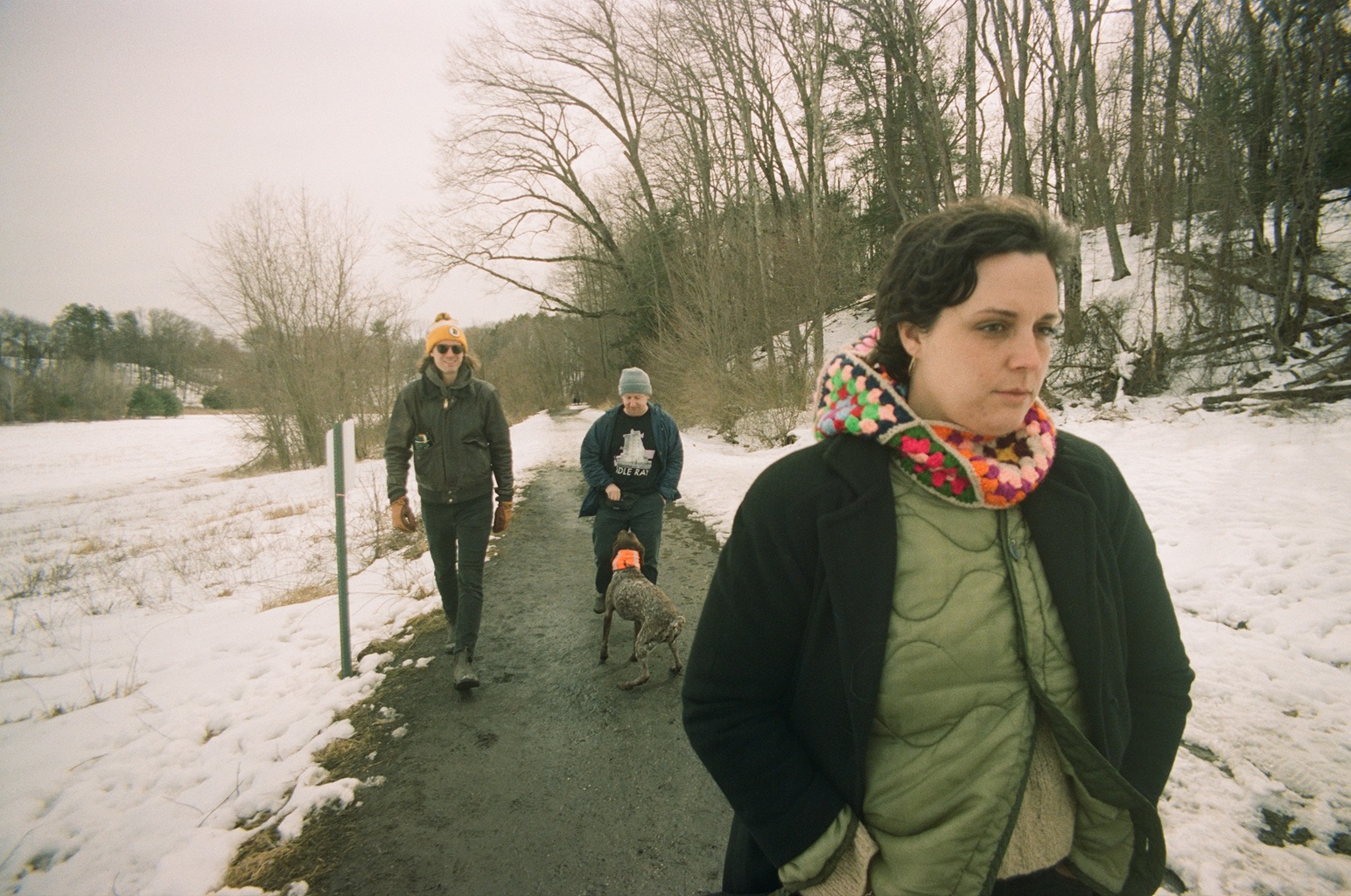
The sprawling sounds created by New York native Ben Jones have been a continual move from the zone of proximal development into a space of comfort and finesse. As eclectic and widely varied singles paved a way to larger collections, the culmination of change, growth and clientele, has yielded an exquisite debut album. With drummer/vocalist Nora Knight and longtime bassist Spike Currier entering the fray, the outfit solidified themselves and their sound. The resulting record Moonflowers is the embodiment of these travellers and tales as told by them.
Gathered from the vast, nebulous vagaries of conceptual notions and coalescing those intangible ideas into solid sonic states, can you explain how you attempted to distill the ideas for this record, and ultimately achieved it in the collected works of Moonflowers?
Wow, what a beautifully wired question!
Nora (drums) joined the band in 2023, and on the very first day we met, we wrote a song together instantly. We work so effortlessly together. She has this ability to tap into that unified field and come up with ideas on the fly. She has such a grounding, calming presence, and it feels like I found another half to my creative self. I think the combination of Nora joining the band, my years of dedication to music, gardening, and meditation, plus the experience of Spike, Nora, and me touring for so long—becoming one mind, writing new material, trying new things every night, and having different people join us on the road, all led to this record.
The album included an array of contributors such as Fred Thomas, Katie Von Schleicher, Cassandra Jenkins, Shahzad Ismaily, Steven R. Smith, P.G. Six + more. Was this large number of transient musicians the secret in keeping a perfect balance and harmony within the writing and recording processes, simply because of the semi-permanent nature of the contributors?
I think it’s like casting a movie, you look at what the story needs and then think of the right person for the role. It’s also a beautiful way to stay in touch with friends and collaborate on something creative. One of the longest-running collaborators in the band, Emma Conely (violin), and I have been playing together since 2007. She lives in Portugal now, so I’m always looking for an excuse to reach out, catch up, and work on something together. Emma Young (lyrics) is someone I grew up with and have always admired, and since I wanted to improve my lyrics, it was a great opportunity to spend time with her and learn from her.
What type of conversations do you have when engaging with other musicians and trying to understand what is needed on a particular track or record, and aligning their technical idiosyncrasies with the group collective?
I usually follow the David Lynch method when it comes to involving someone on a song or album. I choose them because of what they do, so I just let them do what they do best, and maybe steer them a bit afterward. I want it to be creatively stimulating for them too and let the song go where they hear it going. Even when we tour or play shows, we’ll sometimes have people jump on stage, and I might not know exactly what they’ll do, but I trust their instincts as musicians and artists.
The medium and modality of other art forms certainly influenced the course of this record as ‘Time Measured in Moonflowers (feat. Cassandra Jenkins)’ and its nod to Hayao Miyazaki and the symbolism of wind, movement, and time. When drawing upon various other types of art, how do you channel it into the more familiar space of music?
I write a lot of music while watching movies so I will often put something on that is intellectually or visually stimulating and that will create a mood and a feeling to write in. It helps me turn off my critical brain and just let the music happen without judgement.
Never one to stand still, the form and function of Constant Smiles has always been an evolving beast. In pursuing a style at any given moment is certainly one method to capture the pure essence of a scene and sound, but by the same token, does the desire to move from one genre to the next have its limitations due to the brevity of the short space of time spent in that sphere?
That’s a good question! I think that’s probably why I tend to work in trilogies, to expand on those ideas further and really flesh them out. That said, I do believe you can have an entire world within a single song. For example, the first CS track on the first album, “Ultra-violence,” feels black metal–adjacent, which satisfies that itch for me for now. The real limitations are usually the ones I put on myself. Sometimes I get hyper-focused on that sound and only listen to music in that style so I don’t get distracted or tempted to make a completely different kind of record halfway through. But I’ve realized that can be limiting too, and lately I’ve been trying to create more of a melting pot of sounds.
Specifically, what sentiments were you looking to explore on this record, and would you say there is an overarching theme to the album?
The record centers on growth slow– subconscious, and shaped by time. It’s also about loss, and how healing and transformation come through the support systems and community you’ve cultivated.
There have been some pretty unique settings in which Constant Smiles have performed. How integral and transformative are those unusual locations to extracting certain sounds, and the way in which some of them migrate into the way you construct music?
So important, especially for this record since we wrote most of it on tour!
Having met and performed with so many different artists and musicians over the years, during that time, have there been any words of wisdom spoken to you that really resonated, which in turn altered the way you approach your craft?
So many! I mostly talk to other musicians or about music all day, so I try to absorb everything I can, all the time. I was in a band called Drawing Guts for a long time, and I learned everything I know about songwriting from the main songwriter. He taught me to never settle, to always strive for the glory of a great song, and to never feel like I’ve fully arrived anywhere. A big reason I still love being in bands is to stay connected with friends and other musicians, to learn from them, and to get inspired. For example, Emma Young and I would meet every week to work on lyrics for the record, and she taught me so much about breaking down words to get to the essence of what you’re trying to say.
On something of a philosophical note, what does music give you that nothing else does?
Not to sound cheesy but it truly gives me peace. Like my meditation practice, it calms me, centers me and fills me with wonder and ease. It also is a beautiful way to connect with people, friends, and share ideas.