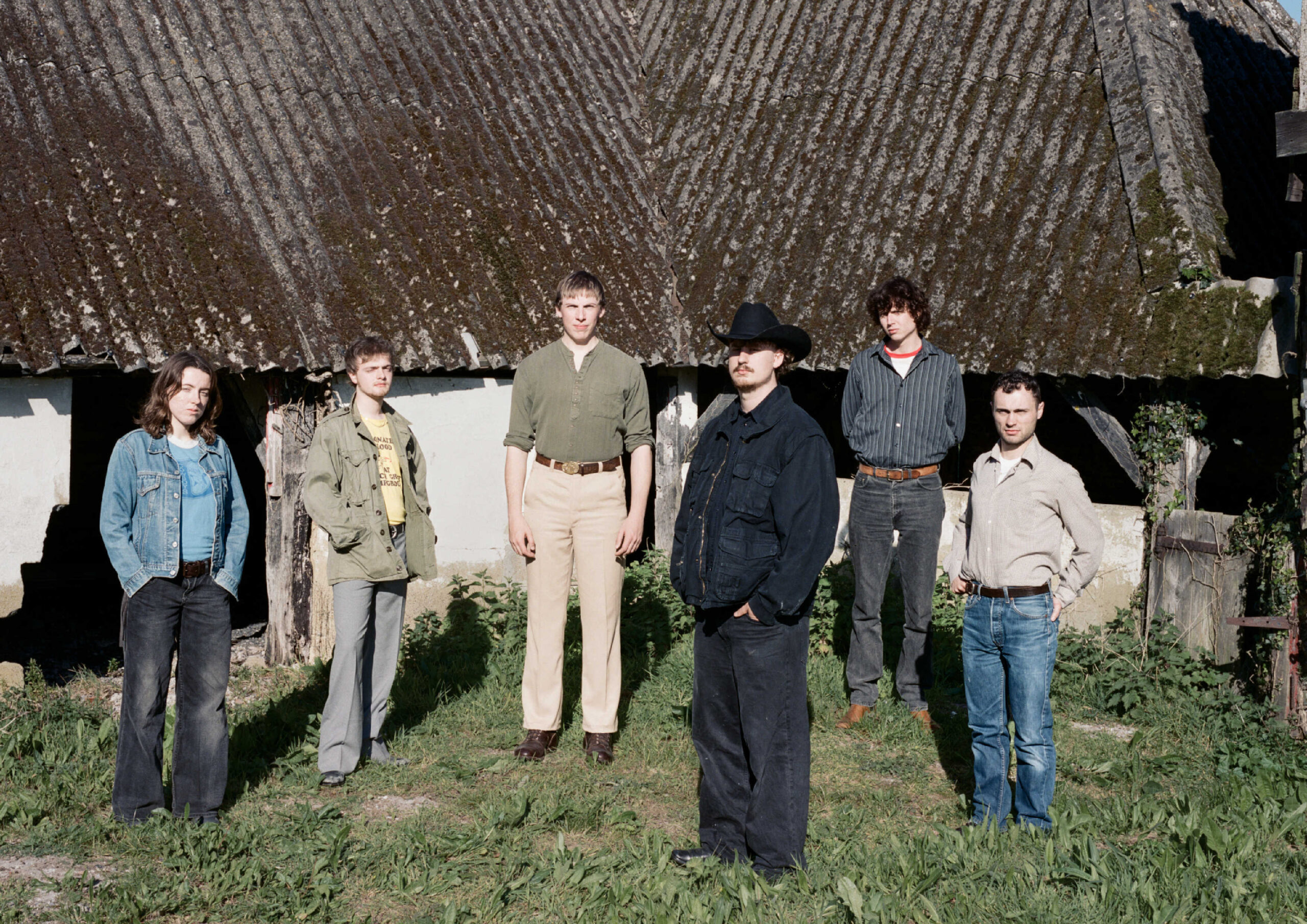
Taking their raw energy and wild performances, the South London outfit has channelled the raucous live shows and distilled their elastic sound into their latest record, as vocalist Joe Love explains.
Hi Joe, and thanks for taking the time out to speak with us at Musicology.
There isn’t much that’s off the cards when it comes to the subject matter that feeds your songs, and in casting your creative net so indiscriminately, when you invariably have to toss back the bycatch, what does that say in terms of where the boundaries of expression start and end?
I think maybe certain stuff you don’t want to bait people out. I don’t want to bitch about people. I think that’s bad in songs when people just chat shit about people. You just want to chat a little bit.
Corralling chaos into tangible order isn’t an easy task, but you manage to distill that mayhem into sound. What is your method for finding the right conduit to pass one form of energy into another?
I don’t really see it as that chaotic. To be fair, I think it’s more an energy thing. It’s like just wanting to convert live energy onto a record. But it’s kind of hard because it’s not the same. Like playing a gig is kind of loud, and there’s lots of lights and shit, and more visual. I feel like you can do it a little bit with some songs, and sometimes that’s why loads of people have live tracks.
Is there anything you do in the studio to like try and capture that energy?
We play as a band, so we try and do as much stuff as possible when we’re playing live, and then we’ll work on that because when you’re playing live together, you can capture that energy.
There are clearly deeper issues which you tap into that resonate with your audience, and what is it that you most feel when connecting your ideas with those of your fans?
Yeah, it’s nice. I feel like this album has a bit more lyrics and stuff. I think the main thing is connecting live. It’s just the feeling, the energy. There’s not really a theme that I’m trying to convey. It’s the energy that you’re trying to give across.
In what ways did your debut and the lessons learned from that record, influence the course of your follow-up?
I think we just wanted to make it have two sides to it. I think the first one was a bit more intense, and that’s cool, but we wanted to have some more dynamic points and try and make it have some variety of pace.
It is an eclectic mix of genres and subgenres that you drew upon in producing your signature sound. Can you discuss how you try to expand and redefine the styles that you meld into your music?
I feel like if it fits in our set, then it’s a Fat Dog song. So if it sounds a bit too out there, it doesn’t really fit. Maybe we start doing some sort of jazz stuff or something. Maybe it would work, but I think it’s just seeing what fits into our set and see if people don’t boo it when we play it.
Yeah, maybe a jazz album for number three?
Yeah, that’s number 10. It’s gonna be number 10
Can you elaborate on the group dynamic and the less obvious ways your relationships translate into the music you are creating?
I suppose the songs only come together or feel a bit more fully formed when we play it live. We want to see the crowd reaction and then that’s how we see if it’s working or not.
So you like writing songs, playing them live, and kind of testing it that way, and then reshaping them from there?
Well, kind of. For this album, we didn’t have the time, so I had to just do it. But we did play quite a few of them live, but the slower ones we haven’t done, but maybe you don’t need to ever do those ones live. I think loads of bands have just album tracks, and that’s cool. Just keep it like that.
So you haven’t played any of the slow ones live?
We’ve played Aliens. I like that one though because it’s a bit more epic and it’s good to have at the end of the set because people look like they’re gonna pass out, so it’s nice to have a nice five minutes of chill.
You have done your fair share of touring and have plenty more shows to come as you embark on your run of gigs Down Under. Can you share with us some of your touring highlights (and lowlights)?
I’d say like the American one was pretty good. I got married and there were some high points. We were like having the best time in Vegas and other place like Seattle.
What was it about those places, the cities or the crowds?
Well, it definitely wasn’t the crowd in Vegas because there was about six people there. I guess more the touring that was fun, like going through random fucking places like Vegas and but there was some down bits. Chris had nearly had a bit of a mental breakdown. I think it was because we make him do a crab dance and he had an epiphany that we all thought he was a joke. But then he’s fine now. That was a momentary like slip. We were all tired, but after that we said ‘you don’t have to do it anymore mate. All good.’
During your time on the road and performing with an array of artists. Have any of them uttered words of wisdom to you that have altered the way you approach your craft?
People always say shit that’s gonna stick in your brain a little bit. And you don’t realize it at the time, but it gets stuck in your head for the next like five years, it’s the kind of thing that makes you move in different directions. Like James Ford said “Just make more music, mate. Just stop fucking around and being so particular about one song and just move on and just make some more songs and just stop being too much of a perfectionist about it” because if you’re a perfectionist about, you hear it six months down the line you’re like “oh shit I was focusing on the wrong thing”. But I think, that’s how it goes.
Do you tend to take cues from your travels that stand out as markers to recall when stockpiling ideas for future works?
I think I wrote ‘Call It What You Want’ after Tokyo because I just wanted to make something that’s got a little bit of that vibe. Maybe not the end, when I decided to make it into a Stadium song.
But I suppose people just say stuff, and you hear something. You hear a conversation from a tour manager, when you’re just sitting in the back of a van, and you just hear people’s conversations, and it gives you good ideas.
Do you start like taking notes of those at the time, or do you just remember it later on?
I sometimes give a little write down, but it’s a bit creepy though, just writing down people’s conversation at the time. You have to at least wait a little bit haha.
I think it’s kind of cool that that sort of thing. I like thinking that you can take stuff from anywhere. It’s more exciting if you’re a musician and whatever you do, you’re taking inspiration from anything. It just means the world’s open for you, and you can always be living in your head and making stuff. Like a lot of this album was just already in my head, and I just needed to record it. Most of it was kind of done, just thinking about it in the back of a van.
What does music give you that nothing else does?
Money haha.
It’s just like the most exciting time. For me, it’s just when I feel creatively and when it’s finished I feel like “oh I got nothing else; I’ve got nothing left to give”. But I think music is great because you can just be somewhere else in your head. You know, like a lot of people don’t have that. They’re constantly thinking about whatever’s going on in the world, and being able to do music is like being able to daydream, and it’s the nicest thing I think.