MARGO MANN
LOVE IS A DOG
“Music is like nothing else to me. It’s a place to make sense of pain, shame, guilt, elation, betrayal, love, sex, misogyny, power.”
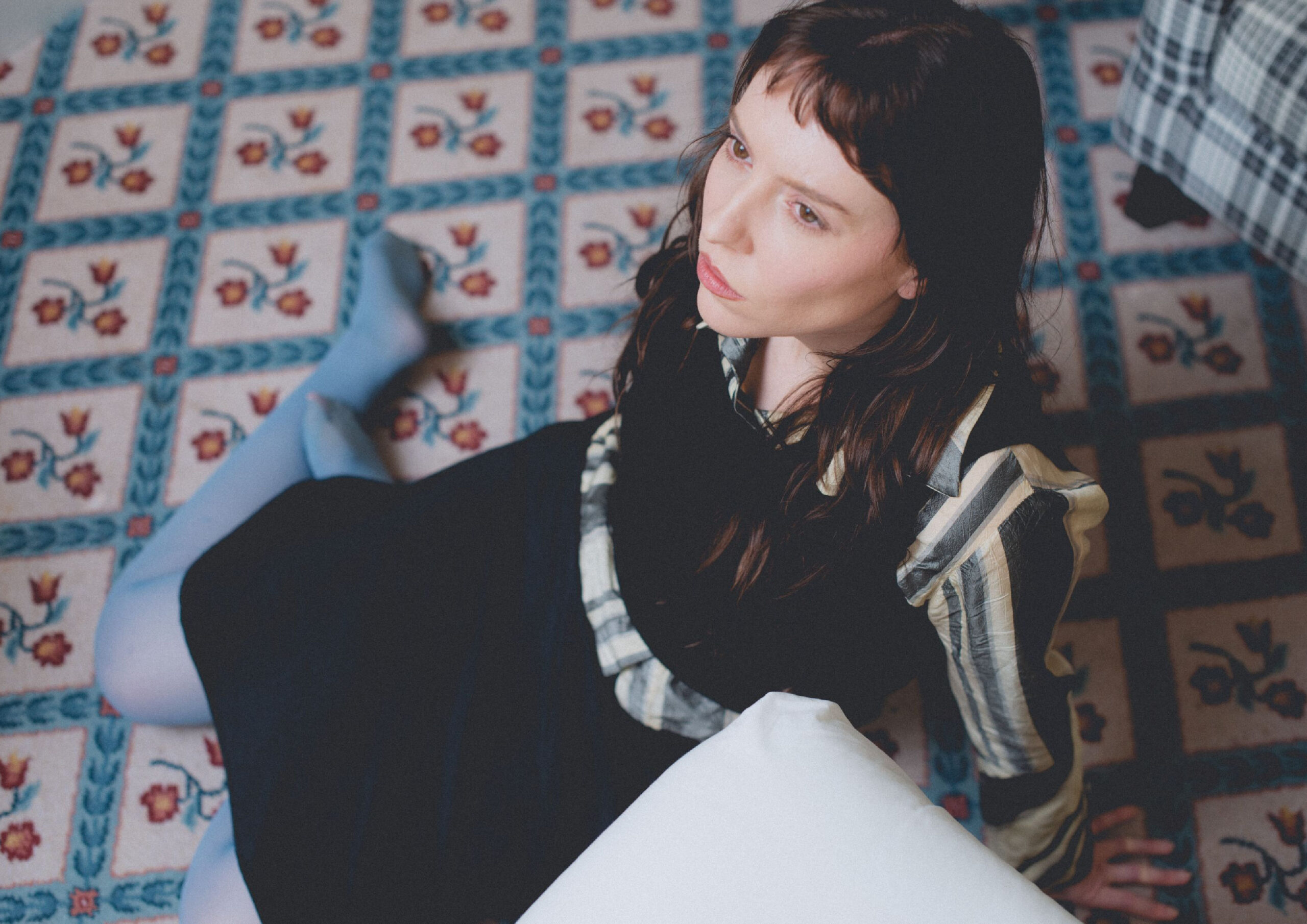
A debut record can be many things, but getting it off the ground to begin with is the first hurdle that many fail to leap. Not so for Taylah Carroll who upended her life in order to record her sonic sonnets and travelled to the ends of the earth in order to make it happen. Love Is A Dog is that result and a body of work that enshrines her power and passion.
Hi Taylah, and thanks for taking the time out to speak with us at Musicology.
Going for broke and throwing everything at this record, including selling your possessions to fund the album and haul the band overseas to record it. That level of effort is only matched by your belief and commitment in it. Just how therapeutic was that particular process in achieving the release, nay, vindication in your self-assuredness?
I’m very much an all or nothing person, so it was pretty in character for me to make a record in that way. In terms of it being therapeutic, whenever I’m feeling restless or lost, I often feel the need to burn the whole house down to check the state of the foundations. I’m making analogies up now, but it’s true. Bleach your hair, cut it all off, quit your job! Stitching yourself up can be as good as a holiday.
I just wanted to make a debut album that I could stand behind, and that meant pouring everything into it, in every way I had means to.
It felt like a really long time coming.
Speaking of throwing everything at this album, being your debut, it is no doubt a record full of tracks that mark significant moments in your life, both past and present. Distilling that is no easy feat, and in doing so, how did you tie all those experiences together with a cohesive and unifying thread?
I didn’t set out for continuity; this definitely isn’t a concept album. What I think has ended up being the continuous thread though, is that the album was written through an intensely female lens. At the time I was writing these songs, I was in the process of trying to disentangle myself from girlhood and wrestle my way into a kind of womanhood that I chose. I was reflecting on the ways in which moving through the world as a young woman had left me disenchanted, while at the same time examining ways that I’d also internalised misogyny in strange ways, and often under the guise of feminism.
Specifically, you address relationship toxicity and, in understanding both sides of the story, a lateral viewpoint; yet how considered was the top-down approach? That is to say, the metaphysical and practical aspects of that relationship quadrant?
With tracks ‘Not Love’ as well as ‘Love Is A Dog’, I would say I’m looking at love through that lateral lens (being both the protagonist and antagonist). Where I also take on a more observational take on dynamics objectively, would be in tracks like ‘Grace’ and ‘Kill The Girl’, where I highlight societal and relational mechanisms that have created suffering in my life. I’m yet to write a song that tackles all perspectives at once though. Maybe that’s my next challenge!
In extracting the sonics to canvas the sentiments you explored, you went back to your musical roots, and piano was one such way you coalesced those feelings. Was that because it is an instrument that taps emotional turmoil more succinctly than any other, a safe space to express, or simply a starting point?
I started piano lessons in high school, though I’d usually forget about the lessons and not show up. I wasn’t a very good student. When I first started writing, the piano was easy to write on because all the notes are laid out in front of you. It’s super intuitive.
But then, when I was 18/19 and started lugging my keyboard around to open mic nights and pub gigs, I got a lot of unsolicited “where are the happy songs” comments. Young, impressionable and eager to please, I picked up the guitar and started to write on that instead.
I’m thankful for the exercise, because writing on different instruments really does change the mode you write from. Writing on guitar is more rhythmic and repetitive, and coming back to the piano with that songwriting muscle fine-tuned has probably bettered my ability to utilise rhythm as a pianist when writing, which is cool. I also think the way it’s set up literally allows for my brain to get more creative and explore more voicings and accidental notes and things. But to answer your question, I mainly came back to the instrument because I’m a stronger pianist than I am a guitarist, and because, I’m a solemn and slow-moving creature at heart.
To translate those sounds and finesse them, you employed the incredible producer Burke Reid of Gerling fame. What did Burke bring to the table that really helped you on this album?
I love Burke’s catalogue, he has made some of my favourite Australian albums to date, so it was a real honour to work with him.
Before I had finished writing the record, I was taking Zoom calls with a bunch of producers, trying to decide who to make the album with. What struck me when talking with Burke was how willing he was to really push me, and the record, to be the best it could be. He was frank, which I work best with. But he was always working to pull the work out from me as a writer, pianist or vocalist; he was never prescriptive.
He has a sensibility that refuses to cloud the core of a song. At one point, Burke pulled up a bunch of movie scenes, and they happened to be films that had a defining effect on me as a lonely and misunderstood adolescent, and these ended up really guiding the rest of the recording process. It felt very serendipitous.
He was also very much in the trenches with us. Burke was the first one at the desk every morning, and the last to leave each night. We worked really long and hard on the record across the two-week stretch in France, as well as on overdubs and vocal harmonies remotely, finessing details in the months that followed while I was back home in Australia.
Lyrically, what was your methodology for unearthing those deep and emotive experiences and transforming them into song craft that made you feel satisfied that the words adequately captured your life?
It’s my debut album, so a couple of the songs on the record I’d been sitting on for years. But when I finally locked in to finish writing it, I really examined my craft for this record, sometimes writing in more of an essayistic way than I had before, and by that I mean starting with a concept and fleshing it out to that end, rather than letting things flow through me in more of a cathartic sense, which is how I’d mostly written when I started out.
It’s funny, I don’t think I set out to capture my life. It’s like that thing, write about what you know. I know about my life, and so that’s where the mining happens, but I don’t think that’s where I find the satisfaction in songwriting, so much as being able to have documented something specific, and in such a way that it becomes universal.
There are various art forms and influences you weave into your work, notably poetry and film. In what ways do the different mediums you explore enhance your music?
Poetry and songwriting, I’m actually careful to hold separately from each other. I think they’re really different crafts. Poetry is an easier hit to me, and by that I don’t mean that there’s any less to wrestle with, more that the rush of knowing I’m onto something is more immediate. The denominator, I would say is my love of language. Words can get me heady.
I’m a visual processor, and film, especially films with emotive soundtracks, make me feel completely embodied and moved in the most incredible way. While we were recording ‘Watch and Wait’, we pulled up the Blue Velvet reprise scene, where Isabella Rossellini performs in the club. It helped me to channel the specific character I wanted to perform the song.
With the clarity that hindsight affords, post-production, how do you see your body of work from the standpoint of where you started this project?
Making this record was so incredibly life-affirming. I came back from France feeling like I’d unlocked a secret universe, one that I couldn’t wait to share. Now that more time has passed, I can see that this record charts a process, and has me kind of freeze held, hanging mid-air in this very specific form. It’s both strange and cool to look back on.