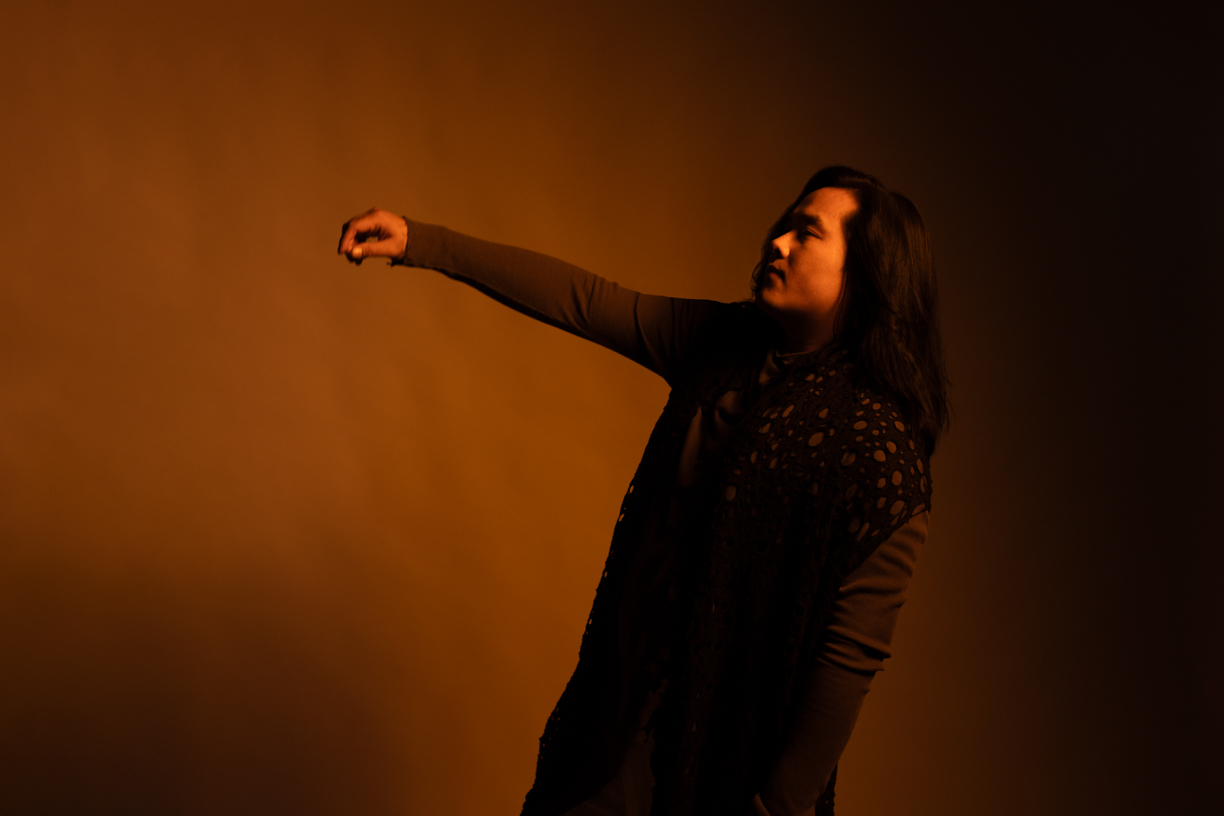
Aysanabee (ace-in-abbey) is a two-time Juno award-winning alternative indie artist, multi-instrumentalist, producer, and singer-songwriter. He is Oji-Cree from the Sucker Clan of Sandy Lake first nation, a remote fly-in community in northwestern Ontario, Canada. now based in Toronto, he began creating music under his family name when moments of stillness allowed him to slow down and create music that more accurately represents himself as an artist.
Hi Aysanabee, and thank you for taking the time to speak with us at Musicology. Congratulations on your latest record Edge of the Earth.
What are some of your earliest musical memories, and how have they guided your career as a musician?
My earliest musical memory was playing my brother’s old guitar in the wilderness of northern Canada. I grew up in a home without electricity, so I would say that left little to distract me from progressing at guitar, spending time in nature, and writing about the world around me and within me. Music became a teacher, music became a friend out there.
Living amidst such a powerful landscape as you do, in what ways do you find yourself connected to it, and how does it speak to you, which is communicated through the music you make?
I live in a big city now, so the landscape is a busy one, where everyone is trying to get by, but if by landscape you mean the community I surround myself in, my surroundings as a touring musician or the landscape within, then, as I’m sure as is with any emerging musician, it is chaotic. We are shaped by our experiences physical and emotional. Travelling the world and performing on one hand can be the most rewarding when your standing in the audience seeing the connection between formed in real time and sharing in human experience, sometimes it feels like a travelling circus, so there are extremes, and I don’t mean that it a bad way, the life of a travelling musician is wild to say the least and functions on little sleep , a lot of drive and a deep love for those special moments of sharing art. I think those shared spaces make this whole thing worth it.
On an interpersonal level, the album is interwoven with commentary between loved ones and shared experiences. Can you elaborate on some of the instances that went into the formation of the songs and how the lyrics were shaped around those moments?
I think since being in this space of making music for a living, it’s a wild place I have never thought I would be, and leaves me little time for a personal life, and with that, less patience I suppose for certain aspects of it. I wrote a song called ‘The Way We’re Born’ which was around the ending of a long friendship to someone who had wildly different ideals than me. I suppose I was tired in that moment of trying to explain systemic inequalities or personal experience, and it became a breakdown of communication, two opposing forces unable to stop each other, and I just left it at that. Releasing the song has made me reflect on this and reevaluate how I approach important conversations moving forward in life, because change, or at least perspective only comes from patience and dialogue.
Having recently lost your grandfather Watin, did this squarely bring into focus the multigenerational importance of your music and how it speaks to the past and the future?
There is always the grieving process of losing someone you love, which I wrote about in the new record, but also in writing a record that immortalized the story of his life definitely lifted a burden from my shoulders, a lot of our stories are oral, so when an elder passes it is like losing 1,000 chapters forever. My debut record, Watin, named after him, to me, felt like this, his story is safe, his memory is safe, and it touched so many people’s lives, including his own and my own. The power of being heard, of being seen, and of being understood.
Filming in the Naotkamegwanning First Nation as you did, what localised elements did you want to highlight, and how do you think they translate to a wider and more global audience?
The song ‘Without You’ is about feeling his loss. The music video has some hidden elements, even though it’s not where I grew up, it’s very similar.
My grandfather loved to ride snowmobiles, but after his son, my uncle, perished going through the ice on one, he never rode one again. Me riding through the icy blue horizon is a breaking of cycles, it represents healing and going forth into the unknown with all the teachings he gave me.
Using your music to champion the cause of fighting against identity erasure, discrimination, and that of privilege and systemic injustice. Where do you see the greatest injustices in the current socio-political environment, and what do you feel is the best way in which to shine a light into the dark corners of the world?
That’s a tough question because they’re pretty much everywhere, sometimes unintentionally. I don’t feel like it’s my job to change everything in the world, I just write what I see and write what I feel, and I only see so much. I am just adding to a greater body of storytellers and of perspective, in this case my own perspective, and I am grateful when it impacts people to want to do better. I am also grateful when people simply enjoy it for what it is.
It has been an enduring push in order for you to make it to where you are today, and specifically in regard to the music industry, what would you say has been the most difficult challenge?
I think the hardest part about being an artist is that an artist has to be more than that now. You have to keep up with social media, algorithms, streaming. Making art isn’t about just being in a live setting an organic setting, it’s very much about being digitized and online just as much. If you play a show and didn’t film it didn’t it really happen? In ways it did haha, but we have to capture so much of ourselves now, and how much do you keep for yourself and how much do you give to everyone else. It’s a fine line of finding time to fill your cup and giving it away.
For those looking to follow in your footsteps and the subsequent generation to follow, what advice would you give to musicians and indigenous artists that would help them break through the barriers which exist between the individual, their culture, societal norms, and big business?
I would say just make art that is true to you. The most important thing is to be so very proud of what you do, and you will find others that appreciate you for it, and that is where you will build a sustainable career, with the fans, always, because if you’re miserable trying to do something you don’t want to, what’s the point?
How has your family and the wider area of Ontario helped you in your pursuit of music and in carving out a style that is wholly your own?
Growing up under a rock helped me. I had nothing else to do, so I played, I wrote and I practiced. I was terrible at music when I started. As cliche as it sounds, you can do anything you want to, it really comes down to how much insanity you have. Insanity is just doing the same thing over and over and hoping for a different result. Obviously, try different techniques, but just keep trying to best yourself. I just try to stay curious, always.
What does music give you that nothing else does?
Peace.