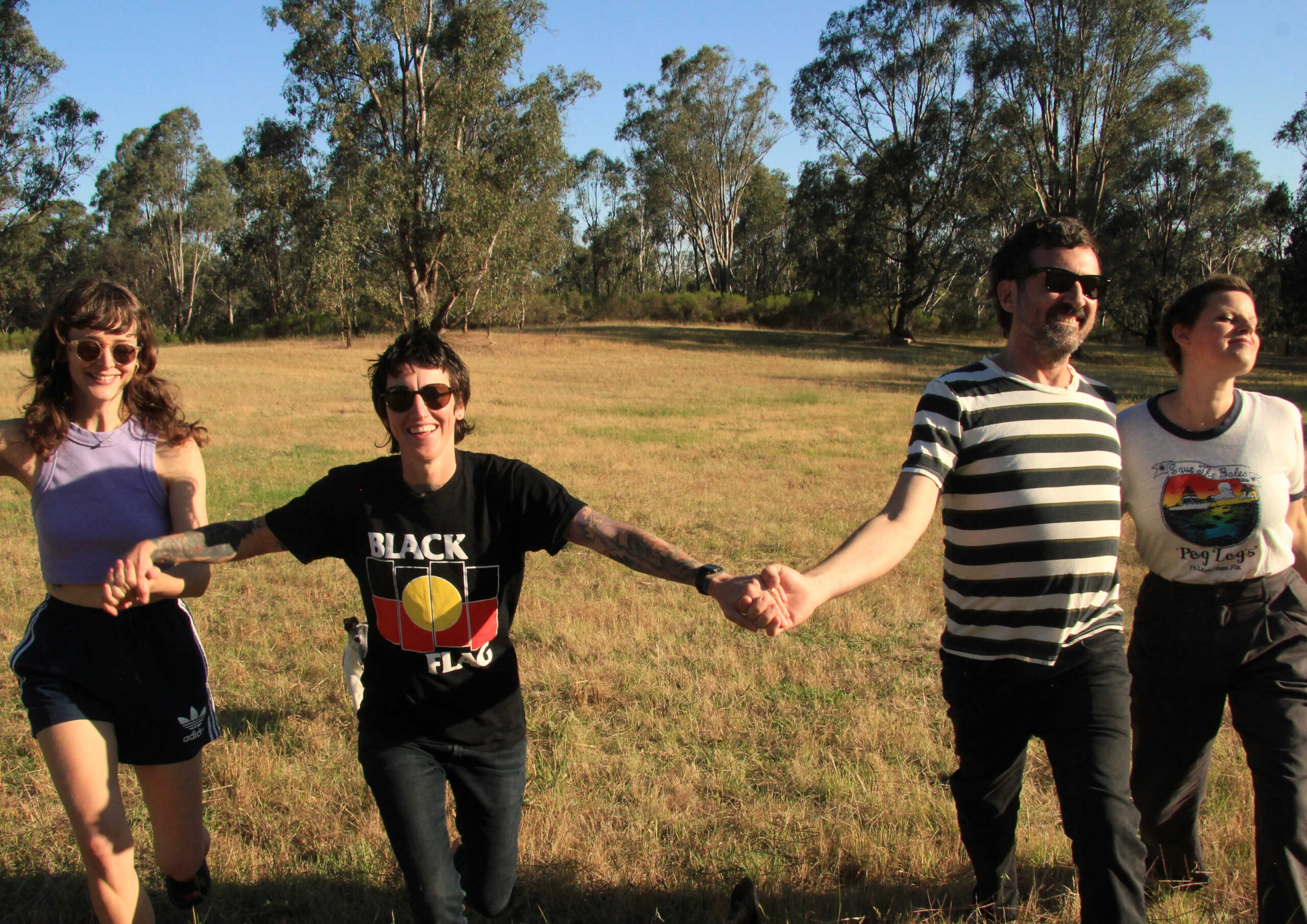
The workhorse foursome delivers another biting record. Taking a stab at the current state of affairs, their tireless ethos of write, record, tour and repeat has yielded another incredible album that further pushes the sonic storylines they narrate with devastating effect.
Hi Gareth and thanks for taking the time out to speak with us. The last time Musicology spoke with TFS it was with Lauren and amongst the many things she spoke about, she mentioned how each album is in its own right time stamped and she was referring to Braindrops and how her father passed away on the day you all were to record it and so her, it will forever contain those emotions she felt at the time which are now enshrined in the album. Fast forward to Fairyland Codex and your own personal take, what of yourself is stamped into the record, and what does it say about your world?
Well, it’s been a wild time because Fi (Fiona Kitschin) when we started the record, was going through all the cancer treatments, so it was a really fucking hard time. But at the same time, it didn’t mean we were going to be Debby downers about it all the time, and we wanted to make a really cool record. We are living in weird times, so you can’t overstate that either, but when we made it we had a good time, as it was summer. We always record in summer because we tour in the Northern Hemisphere during their summer, so we got to hang out; we have this great place in the bush where we do it all. There’s always so much stuff going on when you record.
The ultimate studio, your outback ranch of sorts, is one hell of a recording and writing refuge. How conducive is the remote but wide open space of TFS HQ on your Nagambie property to extracting every drop of creation the four of you can produce?
Well there is plenty of space. I mean, I could be working on a guitar bit or something, and if Erica (Dunn) is writing lyrics, you can just go for a really long walk and think about it, so it’s good like that. It is beautiful, but you have to be careful of snakes and stuff.
It’s that thing…I remember, there is a great singer / songwriter Guy Clark and I remember reading him and he saying that when you are young you need a guitar that is all fucked up and older than you with all its battle scars, and it has it’s own story and that you need that guitar to inspire the stories within you but as you get older you have been in the wars enough yourself, that in the end, any old fucking guitar will do because the stories are now within you.
So in that sense the environment in Nagambie doesn’t matter at all. It’s so beautiful in summer. We have this fucked up old speedboat that we take to the wineries, go and buy wine, go into Nagambie and go to the IGA and go food shopping on the boat; it’s really idyllic. Unless the boat breaks down and you’re fucking marooned.
As you touched upon with Guy Clark and how that guitar mimics where you are in life, Fairyland Codex is a little more of a subdued album in comparison to your previous three. Was that due to reflection, maturation, or diversification?
Well, there are two acoustic songs on there, and we had done a funny little performance movie (Good Goody Gumdrops) during the pandemic, which was mainly an excuse to try and all get together. Fiona and I live two hours north of Melbourne, and Erica and Lauren (Hammel) live two hours west of Melbourne, and we couldn’t get together, but we found out from Amy from Amyl and the Sniffers, whose boyfriend is a filmmaker, and they found a loophole that you could get a permit to film. You couldn’t get a permit to do anything else, but for some reason in Victoria you could get a permit to film, and you could then just do whatever the fuck you want.
So we made that movie, which was great, and we did a bunch of acoustic stuff that was in Good Goody Gumdrops just because we could all sit around the campfire and sing some of our slower songs, and we just realised we enjoyed playing acoustic songs together. Erica is a gun on the acoustic guitar, which is funny because she is really wacky and crazy on the electric; she sounds like a kook, but then when she picks up an acoustic (probably because she was classically trained) she is really good. So we thought we could do this on the new album. We like the slow stuff as much as we do the crazy stuff. It comes down to the fact that we are not spring chickens, and we all have really broad tastes. Lauren grew up on Deep Purple and Sabbath but also Ella Fitzgerald and Coltrane, so she is like the rest of us in that she is really well schooled in music in general.
The eclectic musical interests you each share clearly unite the band in many ways, as the collective musical experience is a shared one; however, is time away from the band and the side project excursions such as Springtime and The Drones important in keeping the vision and directive of TFS aligned and highly focused?
Yeah, I mean you can’t do it to death; you have to have a break. As far as the projects are concerned, the Springtime thing was another pandemic situation where it just happened through serendipity because Jim (White – of Dirty Three) got stuck in Australia. He needed money, and so did I, so I said, why don’t we do something together, and we can make a buck touring when those lockdowns break. So it’s not necessary, but you need to have time off touring constantly.
TFS, we all get on really well, and we have had fights and all that shit. I don’t know if it’s a gender thing or an age thing, but we’ve learnt: just don’t fight. Avoid it; don’t go there. With The Drones, it was difficult fighting mainly because the band was full of 20 / 30 something’s which was more the problem than just having a dick and balls.
As observers, is it the tears in the social fabric, its frayed edges and your fringe point of view that drives the gritty, razor-sharp, and caustic lyricism of your work?
The approach is basically just jump in and swim like fuck. Generally, we’ll come off a tour, have a bit of a break and then all our agents/managers/record labels say, “Alright, time to make another record” and then it’s just a mad dash to do it. It’s a necessity, but you write about the things you see. In one sense, that sounds noble, but I mean, what else are you going to do? How else are you going to make this shit up? It’s easier to look at the newspaper and write a song about something you’ve just read rather than invent a new world.
There is a certain Australiania that TFS embody, and is something you consciously tap into and draw upon or simply an unintentional outcome of how you operate as a band?
You grow up in a place, so you can’t help but be affected by it. It’s where you are; you can read books and see movies about other places, and you can do that all day, but it’s where you are that affects. We are Australians, and I like Australian writers like Les Murray the poet, he is amazing.
Having just come off the back of your North American tour and road testing the new album, was there a lot of finessing that took place and new lessons learned considering how you have been at it now?
You can make a record in the studio where you do every song live, together, in the same space and have the song written and ready to go work on it at the time. When it’s time to go on tour and you have to play those songs live on stage, you have a choice. You can make it hard for yourself or you can make it easy for yourself. The hard way is to replicate it exactly, and the easy way is realising it’s just a bunch of chords and lyrics, much like anything else. If we are going to play a Rod Stewart song, we are going to do it our way, and if Rod Stewart is going to play one of our songs, he is going to do it his way. You’re almost covering your own songs. Some you do exactly the same; it’s easy, some songs take a lot of imagination. Ultimately, you just have to roll with it and let it happen and don’t try and make it exactly the way it was in the studio, because the studio is an instrument, and you don’t have that with you when you are out on stage.
What was it for that matter, some of the challenges and unexpected surprises, when it came to recording for the new album and touring?
In terms of surprises, the song ‘Stepping on a Rake’, people really liked it. I mean, I wasn’t thinking they would or wouldn’t like it, but they really like it a lot. So when we in the States, we were playing it during the soundchecks, and it was sounding good, but it was the end we couldn’t get to work, so we had to get together to figure it out. Usually, at the end of a song you just stand on a distortion pedal and go berserk, but we couldn’t do it with that one.
There will always be surprises because you are making stuff up, and with the end results, we are as surprised as anyone else.
Having worked with and performed with so many different artists over the years, during that time have there been any words of wisdom spoken to you that really resonated and in turn altered the way you approach your craft?
The first thing that comes to mind is more of a business thing. It was 2003 and the first time we were in America and (this is hilarious) but the first American I ever met outside of a venue owner or foldback engineer or something, was Keith Morris (of Black Flag and Circle Jerks) and he came to our first show in America and say “what are ya here” and I replied “trying to make it big in America”. He asked if we are professional and make a living out of this in Australia and I said “no” so he said “you should go back to Australia, tour the fuck out of that to you get to a point that you make a living there and then start going everywhere else otherwise you’ll be chasing your tail forever, you’ll never make a living and you’ll burn out”. That was really good advice, and we did just that.
I have stayed in touch with Keith over the years, and the next time I saw him I told him we are making a living in Australia. He was the guy I heard when I was 14 or 15 and thought, wow, maybe I could be a singer too. I told him that, and I don’t know if that was an insult or a complement but it made him laugh.
I have met James Williamson from The Stooges, my knees were wobbling. Met Alan Vega from Suicide, Neil Young..all so weird. James was one of my great guitar heroes, and I said to him, although it was a corny as shit, “I love your guitar playing; you were one of the greatest guitar players of all time and you were one of the guys that made me pick up the instrument”. He said, “Oh thats very sweet of you” and I felt like I had to quantify what I said, and I told him one of my other favourite guitar players is Jimi Hendrix, and he was happy to be included in such esteemed company. So generally, you embarrass yourself and feel humiliated afterwards.
What does music give you that nothing else does?
It’s a job, for one thing. There isn’t a day that goes by that I don’t feel extremely fortunate, but I also feel that I have worked my ass off. But at the same time, I know countless other musicians (friends and strangers) who have worked their asses off as well and never got anywhere, which is such a drag.
For me it is innate. I can remember being into music before I could hardly even talk. Even before I could read and write, I remember being really affected by music and hearing it on the radio; I wasn’t sure if I should be affected by it.
My great-grandfather, who was the family member I looked most like, talked like and was a carbon copy of, he was a massive classical music fan. To the point where he would sit me down and blast Beethoven at me, and I was like fucking 10 years old, thinking this is boring, and he would just make me listen to it. And then by the time I was 20, I was that guy. I would be at a party and some poor girl who fancied me had to just sit there as I would say listen to the next John Bonham drum fill; it’ll fucking blow your mind, and I never got laid. But it’s innate; it’s been with me since the beginning. Everyone loves music, but they don’t have as deep-rooted a connection to it as I do or my fellow extremo, congenital, lifelong music nerds do.