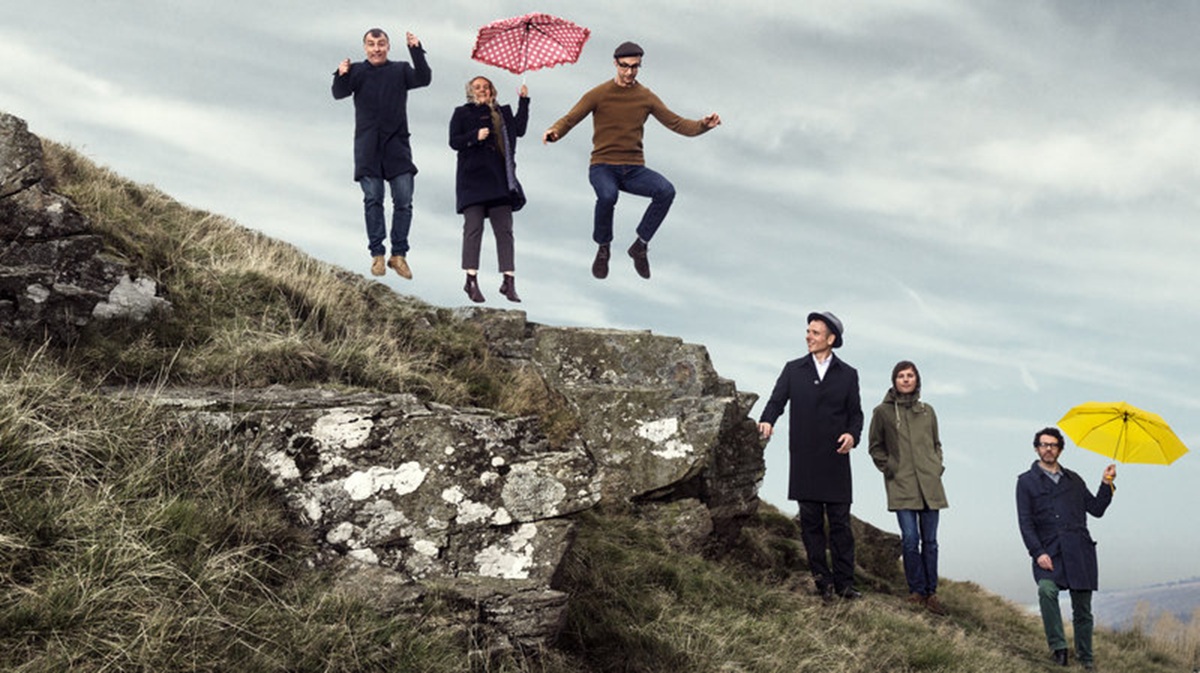
The stream of music that flows from Scottish main mainstay Stuart Murdoch and his collective cohorts Belle and Sebastian is not a trickle but a torrent. The frequency of amazing albums they produce is staggering but with such quantity, the quality of each is far from diminished as we find out more about their latest release Girls in Peacetime Want To Dance and its position amongst the pantheon of the collective works from the sextet.
Hi Stuart, thanks for taking the time out to speak with us at Musicology.
You have a staggering amount of material and are up to your ninth album Girls In Peacetime Want To Dance, where does the ongoing inspiration come from?
Well, I think it has changed over the years. I used to derive a lot of inspiration from the people around me. On our first couple of records, it was my friends and people I would just see around. It’s almost like I would be painting portraits of people and characters and extrapolating what they were like. I guess these days I am writing from slightly more personal experience, at least on this album. Some of the time, I am just trying to get things on paper; it’s a cathartic experience for me, and I am just trying to improve my own life. I think songwriting should be viewed as a consolation, and it helps with the problems in your own life.
So you have found it to be therapeutic in that respect?
Yeah, absolutely, I said to Stevie (Jackson) when we were going off to do this record that I hoped it would be a therapeutic experience because I was in a pretty bad way when we were writing this record, and I didn’t really want to go abroad, but he thought it would be, and it was. I just completely lost myself in the music, and I lent quite heavily on the songs, and I put a lot of store into them, and perhaps that is a good thing. The record is important to me.
In your own words, how would you describe this album?
It’s a good question (long pause), it’s an absolute reflection of where I am at just right now and where the band is at. The idea, I guess, was that the songs have more rhythm to them than traditional Belle & Sebastian songs, and we really wanted to take you on a journey through the album. We recorded 16 songs for the record and then tried to piece together 12 tracks that had a mood that sat with each other. In some senses, it is a soul record, and in some way it is a gospel record too.
As an artist evolving emotionally and musically from album to album, do you find it hard or even redundant to perform some of your earlier material when the person you are today may be completely different from the person you were when you first put pen to paper?
That’s a good question. There are some of the songs that fall by the wayside, and if I were to perform them, I would feel like a phony, but we simply don’t perform them, and there are plenty of the old songs that I would love to go back to. I tend to have one foot in the past at the best of times; I am quite a nostalgic person. I tend to use the past as a sort of well of experience for writing about. So I love to visit those old songs, and every time we get up and play ‘Dylan in the Movies’ or ‘Seeing Other People’, I think about the people I wrote those songs about, and it feels very alive to me. I feel very fond of them, so I feel fond of the songs.
On a personal level what does music give you that nothing else does?
That’s a great question. I think it was C.S Lewis that was talking about the art and the connection between art and virtuality, and he said something interesting. He said that music was the most abstract of the arts, and if you think about it, it is quite true. A painting you put down on canvas so it exists, you write a book and you can see it in front of you but music seems to exist in the ether…where does it come from, it isn’t something we use in everyday language and I thinks it’s that strangeness, it’s a unique entity and to me it is the one that is most connected with otherness, of spirituality. That’s the thing that makes it exciting for me.
When making a new album do you approach it in a new and different way each time or follow the tried and tested method of writing and recording as with previous albums?
It’s a mix of both. We are building on the tried and tested and that’s the beauty of going back to the room with the guys is that you know you can trust them to make a certain kind of music and handle songs so because we are already at that position, that means I can take a step forward with song writing and I am sure Stevie (Jackson) and Sarah (Martin) feel the same way as well. It’s almost like you are free to experiment because you know the guys you are working with.
Does the dynamic of six odd musicians help or hinder the creative force for Belle & Sebastian?
I think it helps. As long as you can remain harmonious on a personal level, then the music will be harmonious. We get on well, and the good thing about having lots of people is that it is easier to make the noise you are after. There is way more variety in the room, and its usually seven people that we are writing with and working together, so I think the more the better. Also, if you have an idea and everybody gets behind it, then you know it’s going to be a good idea. If a couple of people are against it, then you should probably drop it.
Playing for almost twenty years now you must have had some strange encounters and unusual tales, can you share some of them with us?
Recently we were asked to play some songs at the house of the American ambassador in London, a mansion in the middle of Regents Park and so we went along and because we like a good party there was plenty of cocktails and the great and the good from British society were there, it was like a wax work come to life all these people you usually see on the television were standing in front of us and we were playing our songs so that was a little bit surreal. My wife came down from Glasgow, and she slept in one of the rooms that I think Obama sometimes sleeps in.
Do you find touring to be inspirational, whereby it helps you write and create more material or are you so focused on the task at hand that writing and creating new material takes a back seat?
It takes a back seat. I would love to be able to say that it was instantly inspirational but I think because we work so hard at the show we have to work so hard to keep the show fresh and changing the set every night and so on that it is difficult to write but I do jot down little sketches and ideas and I put them all in the pod and I think about that stuff afterwards. It is always when you go somewhere new that the experience sinks in and there was one time that there was a run shows and we were in Argentina, Chile and Columbia for the first time and it occurred to me that the people I was meeting that their life was so much more interesting than my life and I had this notion that I would go myself to these cities and meet fans of the band and interview them and try and write a song and try and do ten people in ten cities and that would become an album but that project hasn’t happened yet.
Is your subject material largely drawn from the average person, the average life?
Of course, I think the palates of characters I used to write about were wider because when I was younger, everyday life and people had an exoticism about it, and that really interested me. I had been ill for a long time, so I didn’t have a job, and I couldn’t really leave my house that much, and so I used to just write about the characters in the city, and that would interest me more, but these days I tend to lean on those people you love or people you want to be with more. The songs perhaps, are more about desire and consolation.
There is a deep empathy for the human condition, which is often reflected in the portrait imagery you use on your album covers. How do you go about choosing the artwork and humanizing the subject matter?
I love to do the artwork and take the pictures. To me, it is the cherry on the cake, it’s the chance to in one image encapsulate the record. It has changed a little bit over the years but the last record we wrote Belle and Sebastian Write About Love we only had a day or so after we got back from California to get the whole thing together and it was a friend of my wife, it was a very simple shot and it was like one of our early album covers and it kind of suited the record but with this one it was almost like a dream about a girl who was robot from the waist down and a guy from the waist upwards and this weird post world war two thing so I went after that and had to work quite hard with designers to get that whole thing together but in the end it ended up being an esoteric picture.
After playing countless venues around the world, you are back in Australia for the summer and will be playing as a part of the Taronga Twilight series, is this the first time you have played at a zoo?
It will be the first time we have played at a zoo. There are lots of kinds of places we haven’t played in, so this will be the first time.
What can we expect on your Australian tour, will you be focusing largely on new material or treating fans to a collection of their favourite tracks?
Whenever we have toured in the last ten years, it has been a broad mix of the old and new, but we will try to focus a little more than usual on the new tracks because we feel that these tracks deserve to be played live. They are quite extravert but to sweeten the deal we have made a little film to go with the new tracks we play, and we are going to use projections, but we will certainly dig up some old songs they haven’t heard for a while as well.
And did you have a big hand in creating the accompanying footage?
Yeah, well, I didn’t direct it, but we have a great production company in Glasgow, and we supplied them with the ideas and looked at the edits, and that’s all a part of the fun.