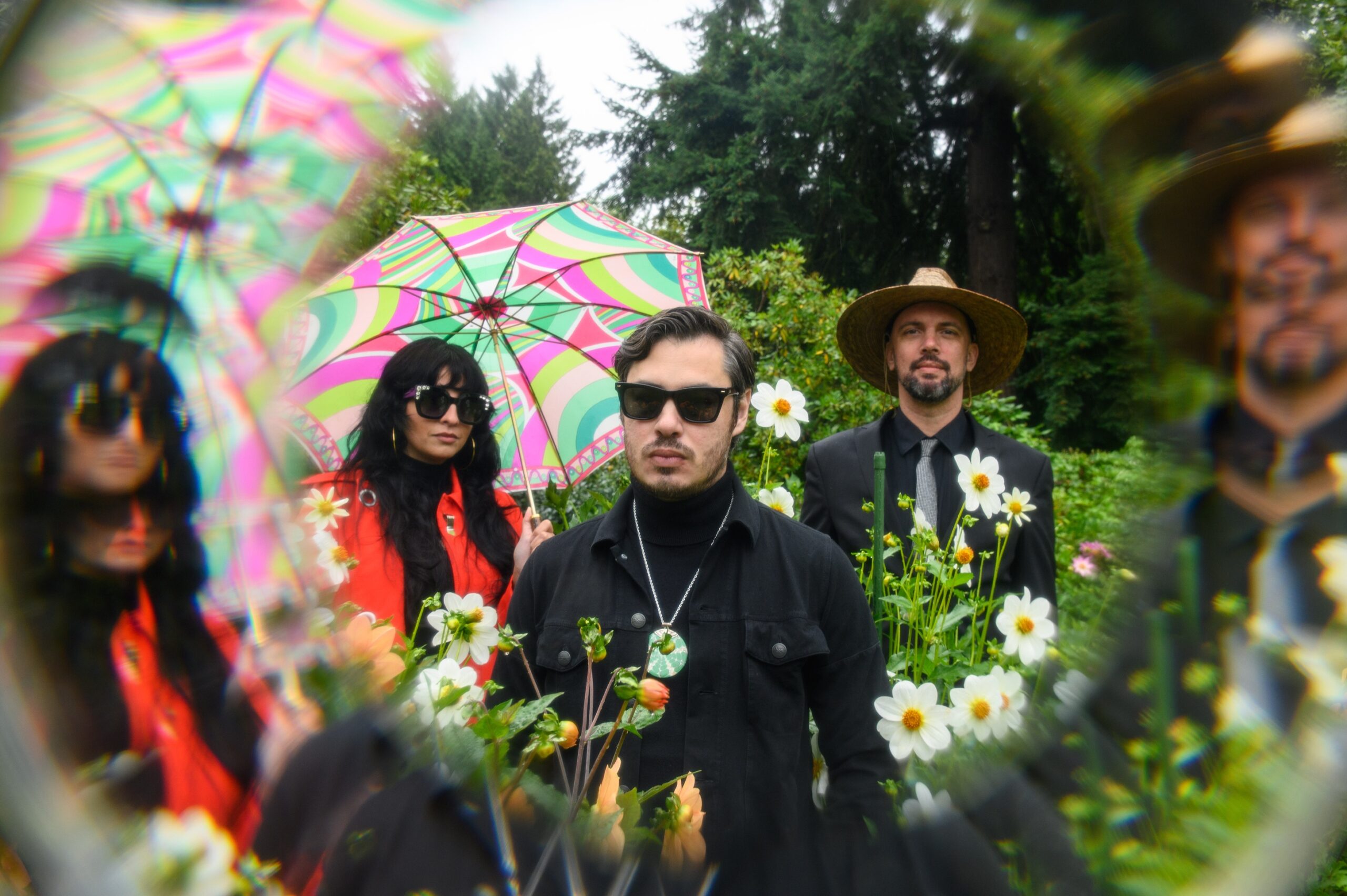
A mainstay of the Seattle scene, garage-psych trio Jordan T Adams, Christopher Garland, Maria-Elena Herrell – collectively known as Acapulco Lips – have been not so quietly championing their sound for years. Their latest record, produced by Killroom Records co-founders Ben Jenkins and Troy Nelson, Now was recorded at their Georgetown studio and is a stunning reminder of the power and perseverance of the Pacific Northwest.
A staple of the Pacific Northwest underground for over a decade now, it is fair to say that you have your own signature sound yet within that contains elements reaching much further back as the Garage-Psych Rock, 60s Girl Group aspects attest. Does having a solid foundation of iconic scenes help drive the creation and continuation of your own or do you feel those styles run parallel rather than overlap?
Christopher: We take from the past. The influences that we listen to are mainly ’60s garage, psych, girl groups, and we take those influences and try and make it our own, but enjoying those sounds is one similarity we all have. We try and meld everything that we listen to into something that we like, where Maria kind of grabs from the girl group melodics, I grab from the garage psych tones, and Jordan – I think you have just more of a livelier presence with your drumming. So all that kind of accumulates into something that is unique, but has a familiar sound.
How has Seattle shaped your sound and in turn how do you see yourselves shaping the Seattle scene?
Maria – I think just acknowledging the obviously very impactful influence of the Pacific Northwest on music, especially rock music. The Sonics, and Paul Revere and the Raiders are two bands that I can think of right now…because we grew up in the ’90s, Nirvana and all of that era probably has a subliminal impact as well. But I mean, as far as I think about Seattle shaping us or us shaping Seattle, I think we’re lucky to be a part of such an excellent music scene. You know, where I think there’s room for everything. I don’t think influence ever goes in one direction.
Having each played in other outfits, what drew you to this project, and in what ways did your previous bands influence the course of Acapulco Lips?
Jordan – I was drawn to this project because I just left another band, which took it very seriously, but forgot what it was like to be a band of friends. I was drawn to this project as well, because the music rips, and I love to play fast, energetic drums. My previous bands continue to influence the course of Acapulco Lips, both in music and interpersonal relationships. I feel like with this band I’ve been very intentional, and we’re all very intentional, about making sure everyone is happy and content and treating each other well, like friends. I think we’ve all focused on that, which is the reason we’ve been able to remain a band for so long, and in each other’s good graces. I think people forget why they start bands, and it’s normally because they want to be in a band of friends.
The concept of time is such a dominant one that runs throughout the record. Capturing reflections and shards of the past is often a difficult notion to crystallize into sound. What approaches did you employ to try and tackle that task and transform it into a tangible quality?
Maria – Come up with the Bones of the song, music-wise. And then I think as it starts to really kind of take shape then you know, one of us might be inspired by something. I feel like I tend to let the mood of the song, as it ends up being, kind of dictate what it’s about. But of course, when I get down to writing lyrics, it’s all coming from my brain … So I’m a person who thinks about death all the time. So that’s kind of, I don’t know, when does death come? It comes in time. And so I think that that’s where it goes back to that concept of time, and urgency, and what do you do knowing something’s inevitable. So, whether that’s a happy death song or a bummer death song, that really depends on the mood. The mood of the music, I would say.
Was there a particular narrative you had in mind in regards to the track positioning on the LP and the tale you were aiming to tell across the eleven songs?
Christopher – I think we had a way the order of the songs naturally fit. Throughout, we were referencing the feeling of joining a cult, and sort of the phases of it, so that kind of dictated the order of the songs. I think it was the way we were writing the songs. And then with the concept of time in there, it just sort of starts with how, you know, you go through these things in life where you’re happy. You’re sad. Breakups, all that kind of stuff. And then you look for bigger meaning, so you try and find something that will accept you. So, like a cult, and also like a cult, then you kind of realize that’s not what makes you happy. So you end up wanting to leave. And I think the order of the songs kind of reflect that. So yeah. I think that’s good.
Do you feel that this album is one that you could only have made now, in part due to your own maturation and broader hindsight?
Maria – I think with Jordan joining the band, you know, this is the record that we only could have written with the three of us. And also, our approach to songwriting is collaborative. So anything that we write as Acapulco Lips will only be something that the three of us we could have written together, right? Like it would be a completely different thing, if there was anybody else in the situation. I think it takes time to get to where we are, and to collaboratively write. I think building that trust and locking in with each other takes a kind of understanding, you know, especially with our process. I might say “Christopher, do that doo doo doop thing again”. That makes no sense to probably anybody else. But after all this time, Christopher’s normally like, “Yeah. Yeah I can do that.” Having that level of understanding could have only come from the amount of time that we’ve played together.
At the risk of sounding like Charles Dickens’ Christmas Carol and the ghosts of past, present, and future, in what ways did the album attempt to address the future and how the topics you wrote about affect the today in which you live?
Jordan – The beauty of this album is that it highlights how time is circular, and the future is probably going to be very similar to the past. In our own way, we’re trying to get people to realize that they should live in the present, actively, and with purpose. Because out of the three, the present is the only time that exists.
From your many years of touring and performing, how have those live shows shaped the way you create new works and incorporate the experiences on stage into future recordings?
Maria – I’ve actually gone in the reverse direction, right? I think that what we write has changed our live show. With this record, we were a three-piece. But the things that I think that we kind of pull from are bands with a lot more production. You know, like it may be a four or five-piece band, but there’s also a bunch of other elements being added to that. So I think with this record, we were really ambitious, and that’s what we were going for, those big ’60s productions. On the album, there are multiple guitar parts, multiple aux percussion tracks, multiple vocal tracks, and we wrote them all as a three-piece, so we had to figure out how to get it to that point live, to represent what we wrote. So I think we did it backwards. We thought, this is what we want it to be, and then we had to figure out how to bring it to life.
During this time have there been any words of wisdom spoken to you that really resonated with you which in turn altered the way you approach your craft?
Jordan – Write for the song, not for yourself – and leave space. I used to play fast and furious, and try to get as many fills in as possible. Now I do the opposite. I try to write as a foundational element of songs, rather than an out-front soloist.
On something of a philosophical note, what does music give you that nothing else does?
Christopher – An outlet, where like-minded people and friends can create something from nothing. And a sense of pride, I guess.
Maria – It’s still possible to find or discover things in music, even though it’s been around forever. It could be some cool single that somebody dug up from 60 years ago, and that person has no idea that you ever found their song. It’s such a cool thing. I think just the fact that we ever figured out how to document and record music is amazing, as amazing as music’s ability to find you. It’s like a piece of somebody’s energy from so long ago, and so I think for me it’s really exciting, and I feel very lucky to get to do that. You know, to get to do the same thing. One of my thoughts that I’ve had for a while is that no one’s going to document you sitting there and watching TV. Like that won’t be anything that anyone can appreciate later, but when you go and you make an effort to create something, it’s a point of time, it’s your energy being spent, that lasts. It’s really cool.
Jordan – Being a musician and a drummer is simply who I am. It’s a part of my identity and a strong source of happiness. I’m never going to stop.