ALASKALASKA
THE DOTS
"It’s more interesting to me to wrap up serious concepts and ideas in different ways, in production as well as arranging and writing parts"
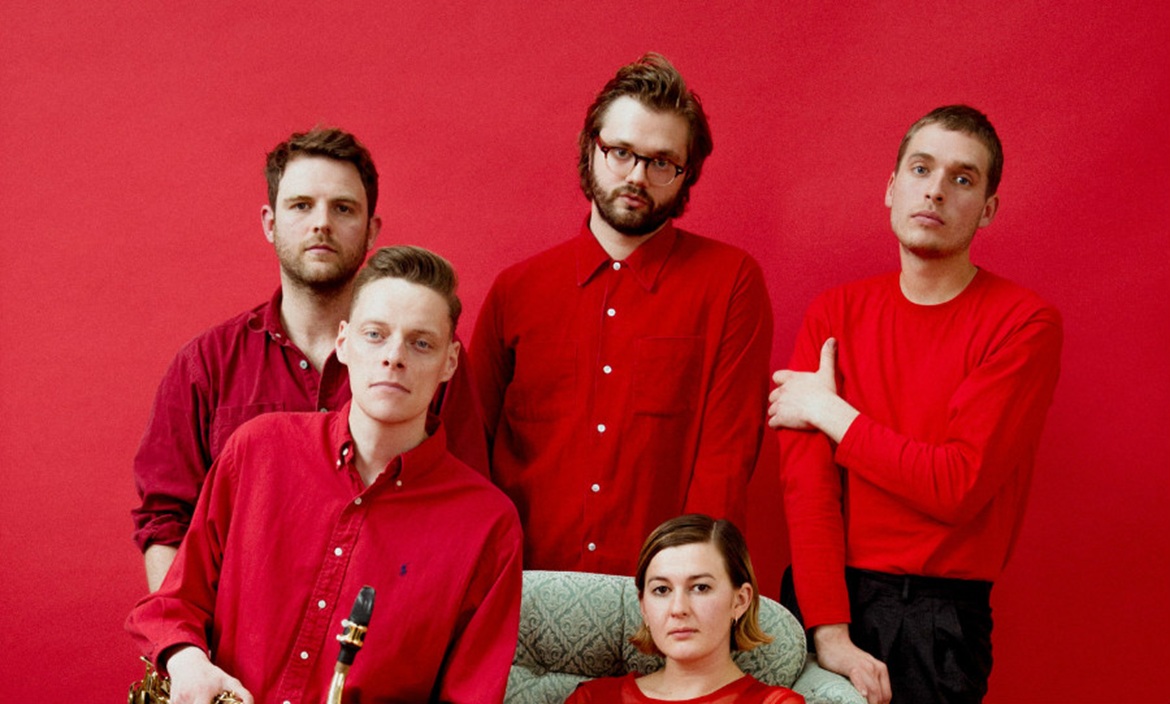
Their socially astute commentary and mix of alt pop make for an enticing brew. After the release of their brilliant single Bees and equally engaging videoclip, the ensuing The Dots is a remarkable entry for this London sextet as Lucinda John-Duarte and Fraser Rieley joins us to discuss the album in detail.
Hi Lucinda and Fraser. Thanks for taking the time out to speak with us at Musicology.
Firstly, congratulations on your latest single Bees. An amazing video clip with its overlay of the hive and rich metaphors. The paired scenes of greed and rebellion both new and old is as energising as it is provoking. Was there a strong storyboard for this clip right from the get go or one that slowly came together as certain imagery caught your attention and how it married with the sentiment you were trying to convey?
Lucinda: Thank you! I knew I wanted to make a video made up of found footage when we decided to release ‘Bees’ as a single. The song was born out of a book I read a year ago titled, ‘All Consuming’ by Neal Lawson, which goes on to explain our journey as a society from consumerism to turbo-consumerism. The first four chapters being “what went wrong?”, “why it happened”, “the consequences” and “what’s the alternative?”. I guess I was trying to convey all that in a nutshell, and what better way to back it up than to match it with real footage from the past, present and future- some more poignant videos than others. I think it needed to have a balance of the very real up against the ‘viral’ natured footage to not only keep the viewer interested (us ‘consumers’, have discerningly fleeting attention spans), but to really help spell out and question what a mess we’ve got ourselves into. ALL IS NOT LOST. WE CAN CHANGE.
The horns piece in Bees is particularly evocative. As music is often the vehicle for expression in terms of identifying and transforming social change, it begs the question of whether you chose specific instruments to express a single emotion or thought with a certain sound to highlight an underlying message?
Fraser: Sort of, it’s not quite as candid or contrived as that, we usually don’t aim to write certain parts to depict particular images or thoughts when we play together, but we each have our own initial response to the song, the feel, the lyrics/melody, then develop it over time to make it compliment or contrast with everything else going on musically. It’s more interesting to me to wrap up serious concepts and ideas in different ways, in production as well as arranging/writing parts, and in this track it’s aimed to create a sort of synthetic grandeur, with the gaudy sax lines and 80s synth sounds, but put against more ominous sounds too, presented in quite a simple, relaxed groove. I like to imagine songs as film soundtracks sometimes… it makes musical and conceptual sense I my head but I don’t try to get too literal unless the song needs it. Although, the synth solo is definitely a giant bumblebee.
Considering the current state of poli-trix both locally in the UK and globally in the wider community, in what ways are ALASKALASKA addressing these issues on your record The Dots?
Lucinda: Personally, I don’t think we are. Not directly, at least. I’m not going to pretend that these songs are some sort of beacon of reason. What they are addressing is my own identity politics. I’m writing through my experiences as a young woman in today’s ever-changing, fast paced social climate. But that’s not to single out anyone. These songs are for everyone- not just young women, alike. I hope that the listener can take some solace from my words, I have been very open lyrically about myself.
Fraser: I think Lu touches on some important political and social themes through the record, but rather than pushing a stance or manifesto I hear it more like a snapshot or presentation of issues and questions that people could be asking themselves. It’s not anti-anything particularly, but asking how do I feel about X and why? Does any of it really matter?
Politics is not the only topic you traverse, as with your earlier release Moon and its focus on the body, specifically the female body. In terms of writing for the album, was it a very individual process with each of you bringing your own elements to the table or one that was collectively fleshed out irrespective of the topic at hand?
Lucinda: It nearly always starts out as an individual process. As I mentioned previously, I write about myself. It starts of as a very self-indulgent, personal thing that develops into a shared cathartic practice. I’ll write the basic bones- the lyrics, the melody and the chords. Then, secondary to that we (Fraser and I) begin to flesh them out, demo them- then it goes to full band. That’s when everyone adds their own flavour to it. I often have a strong idea of the theme of the song- for example ‘Moon’, I wanted it to sound menacing and relentless, much like it’s topic ‘PMS’. With that in mind, the boys and I work together to figure out what that sounds like. That’s when the magic happens…
Often lyrical inspiration is born out grandiose experiences but more often than not it comes from everyday people in everyday situations which ALASKALASKA are most adapt at in consolidating into beautiful sound scapes with a lyrical finesse. What is it about the ordinary that most inspires you into crystallising these moments?
Lucinda: It’s real. We like to keep it real.
Does the writing process speak for your individual musical contributions considering that the ALASKALASKA sound is an eclectic one that fuses so many genres into one?
Fraser: Yes and no, the writing process isn’t exactly the same each time, but generally with this album it didn’t feel like we were trying to fuse genres or ideas together, it just happens. There are a couple of tracks where Lucinda or myself have written the bulk of the track, then ideas have been introduced from the other guys; or at times I’ve arranged chords/rhythms/sequences/loops for us to work from; or tracks have just been born out of playing and developing as a group in a rehearsal room after hearing Lu play the basic ideas to us. After this we take it away, hone in on the initial parts we like, then build them back up with the band or just as a demo. We all have different influences, but the more we play and write together, the lines blur, and the easier & more interesting it gets, and it’s always felt important and exciting to let each band member put their own style and character into the songs – like the distinctive feel of the grooves or guitar sounds for example.
With such richly layered tracks and a masterful finesse in you compositional structures, by prising these layers apart can you elaborate on the technical nature of your production and piecemeal construction through the instruments and electronic equipment you used on The Dots?
Fraser: Yeah there are lots of elements involved. We wanted to retain a live feel to the album, so most of the arrangements are recorded as-live with rhythm sections done together, and tracks constructed as quickly as possible to make things feel real for people to play to. A lot of the synth parts were programmed or played in early on to provide a bed to play on, like sequences or basslines on a Juno-106/System-100/DX7/MS20, or even some basic percussion parts, then we tracked drums, bass, and guides together on top so it felt ‘real’. We reamped a lot of things, used lots of tape delays, real reverbs, vocoders, and almost everything was captured like that, rather than processing with plugins or samples. We tried to keep things sounding dark without getting too overdramatic, and the balance of synths and electronic parts vs natural or acoustic things felt significant in making things feel rich and satisfying without being over the top.
In taking your initial cuts into the studio, you were only in the studio environment for the shortest of periods. Did this time sensitive approach channel you into making sure you had a very refined track before you walked through the studio door so that there would be little production involved and therefore retain its essential core?
Fraser: We tried to be organised for sure. For maybe half of the album I spent a little while making demos to map out the tracks, develop parts, arrange things, and try new things to see what was or wasn’t going to work, when proper production started. Then the tracks were either built from those demos, or a few chosen parts, which were eventually rerecorded or kept in their original because we liked those raw elements and didn’t want to get rid of them. I definitely didn’t want to be too organised or refined with preproduction, we needed to leave room for the songs to breathe and grow naturally, and let unexpected things happen otherwise you’re in danger of things feeling sterile and sounding generic.
With your upcoming tour, is there an approach you will be taking to replicate the album sound on stage or do you intend to have a much more organic live set than that of which features on the record?
Lucinda: A bit of both, I think. I don’t think it’s necessary to play the album exactly as it is – I think it’s important to factor in some live, freer elements to the live show. It makes the show a lot more exciting for the audience and us.
Fraser: Yep definitely, we won’t be playing to a track or trying to exactly replicate it, but it’s been fun rearranging parts and expanding on it to make it its own thing – we’re really looking forward to it.