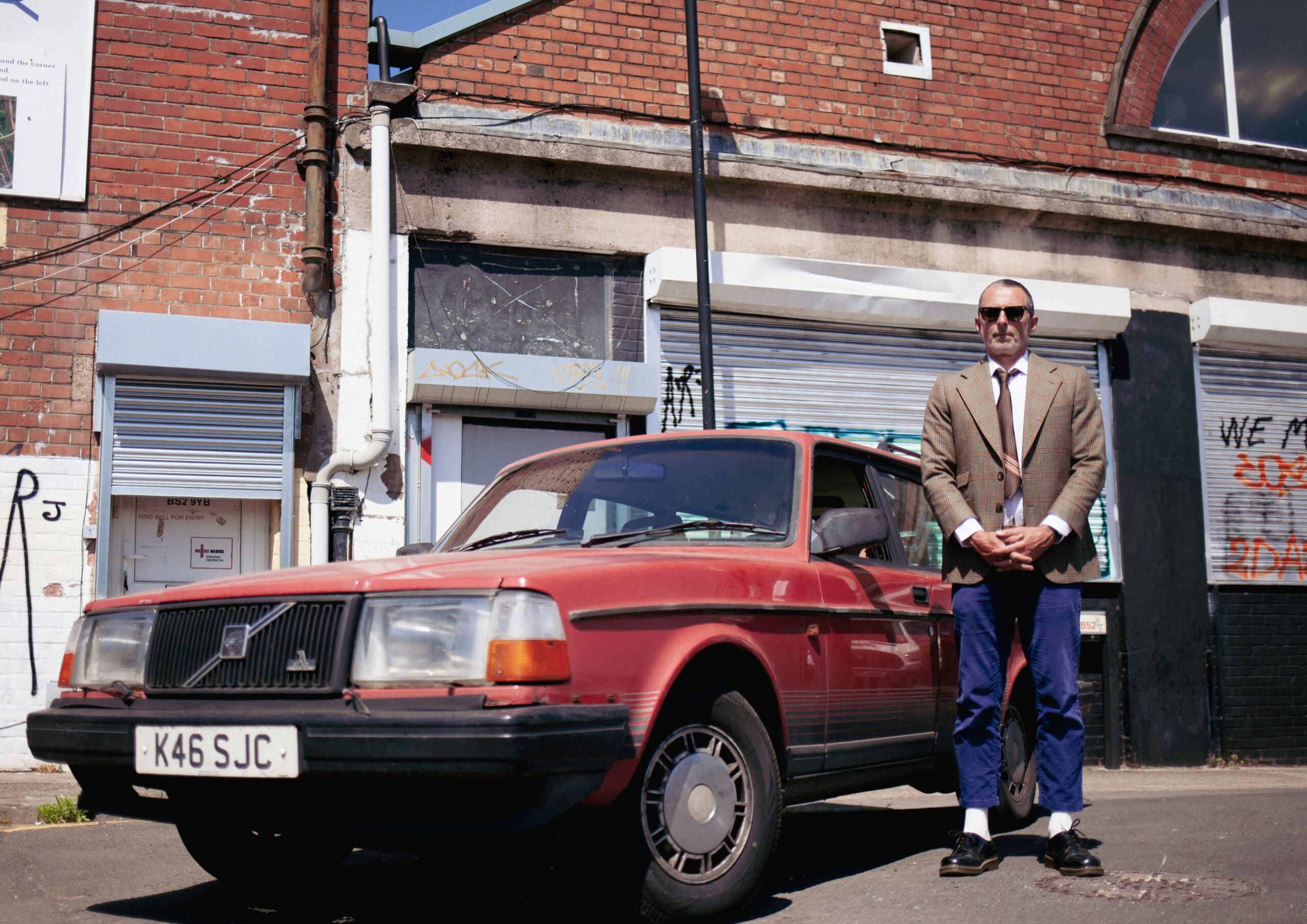
Some things don’t ever stop. And for East Ender Scott Lavene, the urge to write is unrelenting. A ceaseless but endlessly entertaining element of life and a supreme creative outlet. Channelled by music and distilled into albums, his razor-sharp working-class musings have come to embody not only a facet of British society but also a shrine to his life experiences in a part of England that holds a mirror to society. Riddled with humour and humanity, his latest offering Cars, Buses, Bedsits and & Shops looks to continue the self-effacing and honest music that has led to his cult status.
Hi Scott, and thank you for taking the time out to speak with us at Musicology.
My pleasure. Thanks for having me.
Known extensively for your biting wit, caustic humour, and devilish cynicism, can you elaborate on the Scott Lavene writing process and your methodology towards distilling your astute social observations through a poetic filter and translating them into a solid sonic state?
Hey up there. There’s no magic to it. I write everywhere I can, on my sofa, on trains, at work, on my phone, cycling one-handed. Sometimes with an instrument, sometimes not. My poetic filter is a strong one. I write until it’s not shit and makes me interested in it, removing clichés and anything too ordinary.
With your world viewed through an Essex prism, what aspects of your work do you feel directly relate to your East End origins, and which aspects from further afield inform your perceptions and social assessments?
I guess the towns I mention, but I feel it’s mostly a working-class prism I’m looking through, which applies to everywhere and, I guess, is why the music is travelling quite well. It’s also quite a nostalgic prism, 80’s/90’s when everywhere had crappy pubs, boy racers, falling in love on buses, when you get away without car insurance and minor crimes. Now I live in quite a nice area and, especially on my school run, I see the other side, a bourgeois sense of smugness, and it gives me another angle and also makes me grateful I grew up how I did and when I did.
In picking up with Cars, Buses, Bedsits & Shops from where you left off with Disneyland in Dagenham, were you looking for a departure, a new direction of sorts, or simply to continue the tale that began as Big Top Heartbreak?
I mean, I can’t help but be me and write the kind of lyrics I do, but I wanted Cars, Buses, Bedsits and Shops to be more song-based, traditional kind of songs. I love ‘Disneyland In Dagenham’, but there’s a lot of talking on it so on this one I wanted to use the old pipes and belt out a few numbers. And sonically, I wanted it to feel more polished and friendly, a little less punky and eccentric.
There is a great deal of reflection throughout the record, and in recalling all the events that went into the writing of the album, what extra details did the clarity of hindsight and 20/20 vision from those times pick up?
That I’m a soppy fucker, an eternal romantic. And that pain is useful.
Offering a tender insight, ‘A Bus In July’ provides an illuminating reflection upon how you met your wife. Was there a strong sense of looking at the rear vision mirror on this album due to the aging world around you?
Well, I’ve been with my wife for 11 years now, three kids. It’s easy to let life get in the way of what’s important. So my way of looking back is often just to kickstart a feeling, to see how far we’ve come and remember the people we were at the time. I’m so nostalgic by nature, and I’m not sure if it’s always healthy, but I sure get a lot of songs about it.
Would you say that there is a single overarching theme to Cars, Buses, Bedsits & Shops, or is it still very much a collective storyboard complete with idiosyncratic characters whose voices come to life through your pen?
I didn’t start out with a theme, but it turns out all the songs suit the title, which is why I named it that. But the theme is the same as usual, love and mischief. Which isn’t a bad name for an album either, maybe.
The poetry through which you detail your world is as universal as it is unique, and when penning your insights, reflections, lament, and awe, do you at the time of writing, consider the musical landscape to which the words will settle within and how they take root?
Most of the time, yeah. I’d say eighty percent of the time, the lyrics come either formed in my head as a melody or as I’m sitting with an instrument, so I can feel where they want to go straight away. But sometimes I’ll just write, Cars, for example, was a much longer written piece that had no ties to music at all at first, but some things are too good to leave on a page. At the moment, I’ve got pretty much a whole album of lyrics written without any music attached to them. I want to write the music in my studio instinctively, which I’ve never done before as I always have to go into studios with everything ready as I’m always under time restraints. But I’ve got a studio in the garden now so I’m gonna get all wacky over the winter.
The musicality in pairing your vocal narratives and that of suitably apt instrumentation is a harmonious and sommelier-like in its matching, so in working with Ryan Rogers of Mumble Tide and producer Stew Jackson of Massive Attack, Black Crowes, Tom Waits and Nick Cave fame, how did the two take your essence and embellish Cars, Buses, Bedsits & Shops with their deft touch?
Well, Stew definitely has a more American feel to his playing, a more classic sound which I really wanted. And he’s just so good at everything. Drumming, bass, guitar, slide, harmonica. It’s so natural to him. Since the previous two albums had been mostly my playing, I was really happy to just put down a guide to the songs and let them build around it. And Ryan has a really unique style of melody, always playing something me or Stew probably wouldn’t. It was a perfect team.
Is there an off switch, a divide between life and music, and life without music, or are the two mutually inclusive and inseparable when processing daily events and how they relate to each other?
I’m never really switched off. I don’t want to be. I have periods when I don’t pick up an instrument for months, like now, but I’m always writing. I love it. The only time I don’t write much is on tour, though I’ve tried, and there’s often quite a bit of free time. But that’s more a time for musical ideas. I’ve got to know myself now, and it’s important not to force anything, ever.
Being a creative is difficult; being a musician is harder still. How have you navigated your way through the industry, and in what ways has your trajectory altered its course to avoid the pitfalls and strains of an artistic life?
To be honest, I don’t really feel too involved in the ‘industry’. My team is small. The hardest thing sometimes is time. Finding a good time to tour when my wife and I work. I make money on tour these days so it’s worth doing so I feel lucky as it’s not that long ago that I didn’t.
Having released multiple albums and working with so many different artists and musicians, during that time, were there any words of wisdom spoken to you that really resonated with you, which in turn altered the way you approach your craft?
Be nice. Be on time. You don’t need expensive studios and gear. The vibe of a song is better than a perfect recording. And no one really gives a fuck apart from you so get over yourself.
On something of a philosophical note, what does music give you that nothing else does?
Belief that humanity is worthwhile.