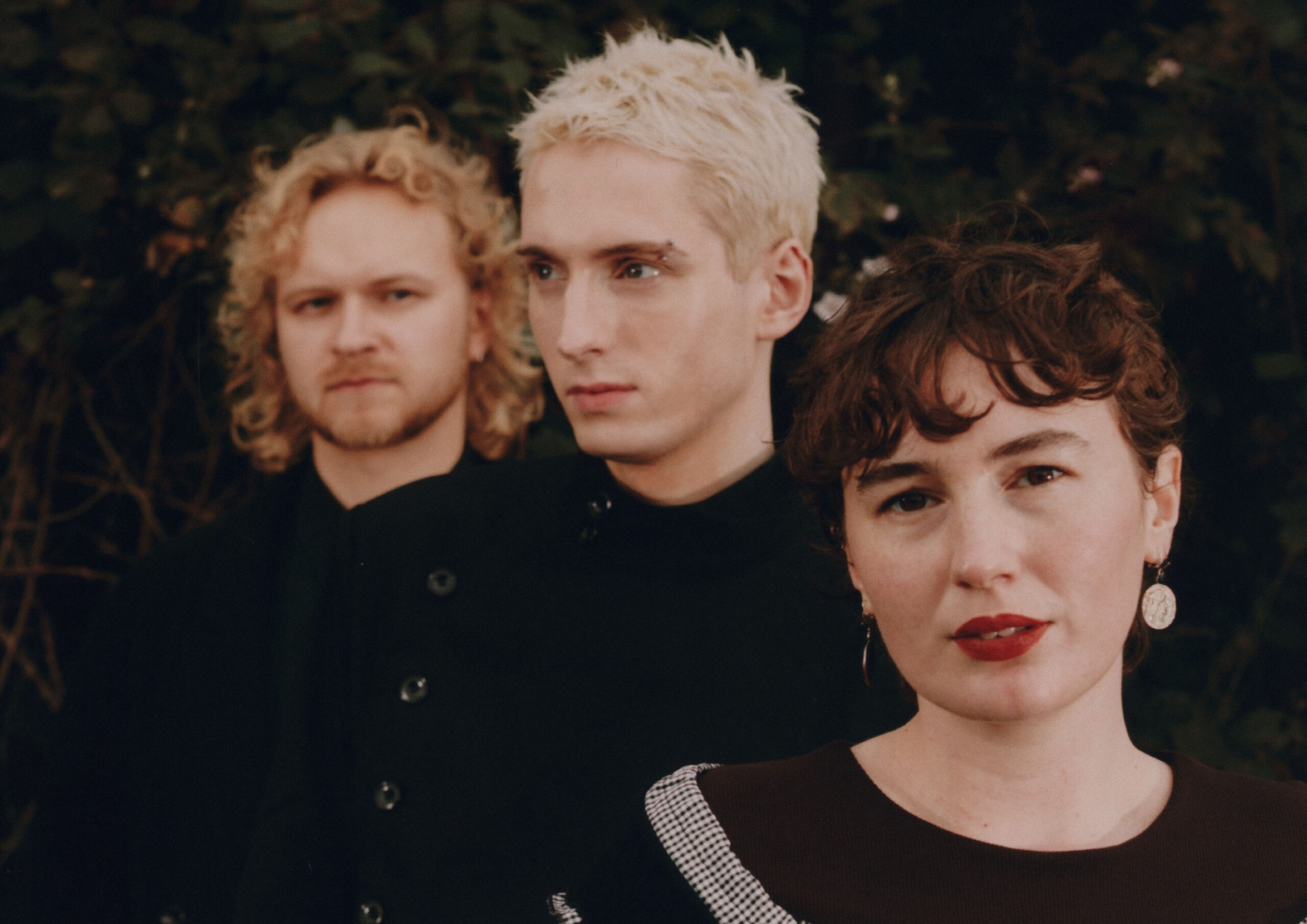
Wearing their creative hearts on their sleeves, London trio Ben Easton, Dottie Cockram and Harry Catchpole draw upon the shoegaze icons of Cocteau Twins, Slowdive, and My Bloody Valentine as they fuse their own signature sound into a peer-heavy scene with their debut record.
You are set to release your debut album, yet it is in some ways a project that has been with you for many years. Slowly evolving into the creation it has become, almost mirroring the changes reflected in yourselves as a band. Was there a point that you had to stop or draw a line between past and present in order for it to see the light of day?
Dottie: This album felt like a changing point for us. We didn’t have a clear vision for it when we began, but as the days went on, I felt for the first time that we saw ourselves as a complete band and were confident in what we were creating.
Ben: We went into this record with a bit more intent, but just required that spark to form into a record. Now that it’s out and the goal we have been working towards since we started six years ago has been reached, it feels very natural to draw a line and look at what the next thing could be.
Can you share with us some of the broader notions the album addresses, as well as some of the highly detailed moments that fed into the making of the record?
Dottie: I found a connection with birds whilst making these records. I suppose it was an overall connection with nature and our impact on it. ‘Garden of Eden’ is very much about this and the effect our human greed has on our world. ‘Smile’ was written at a time when the National Emergency of Violence Against Women was declared in the UK. It became a way for me to write about how I was feeling at such a dreadful announcement and the lack of action since it.
Ben: The album deals with human consequence; on one another, on nature, on mental health. We each had our own issues at the time of writing and recording it, and I think collectively the album served as a kind of therapy or catharsis to help us deal with it all.
It is no secret that you are influenced by the likes of Cocteau Twins, Slowdive, and MBV. In harnessing those classic shoegaze sounds, was it something that helped sonically nurse and cajole some of the sentiments you were exploring?
Ben: They’re always a jumping off point, but we naturally write very emotive music, both sonically and lyrically. We like our music to be layered with different attention-grabbing elements, and I think the lyrical content and themes organically intertwine the sounds.
It is one thing to admire and channel certain artists as you begin crafting your own sound, but quite another when you get to perform on the same stage with them as you have with legends Slowdive. Can you share with us that experience and how transformative it was in how you continue with your own work?
Dottie: I remember watching them play the Troxy in London after us. It was a wash of noise that had everyone transfixed. We were all so amazed that we had the opportunity to play before them. You could tell everyone in the room was so excited to see this band and be a part of this special moment.
Ben: We’d only started playing live a year before, so it was a really early show for us. I broke a string in the second track so that helped the nerves. Mostly, I remember being very amped up, watching them, and just taking as many mental notes as I could. It was a very formative show for us, and we still feel really honoured to have been there.
What have been some of the steepest learning curves you have faced in your career, and some of the pitfalls you have managed to avoid in getting to the point of finally releasing your debut?
Ben: For me, it’s the relationship with anxiety. Anxiety on stage or when you’re releasing music. We’ve learnt that it’s not that big a deal, you can’t control everything, so enjoyment has to be the main goal. We’ve really crossed a bridge into being more confident in our artistry on this record, and it’s far more enjoyable that way.
Dottie: I struggle a lot with imposter syndrome. I constantly feel like I don’t know enough to be doing this. I think this stems from confidence, but also the misogyny in this industry. I’ve had to learn to believe in myself and trust myself! I can make anything I want to.
You certainly hit the ground running with Fairground topping #1 on the vinyl singles chart in the U.K. How has this affirmed or reaffirmed the direction you have taken and where you see the band going from here?
Dottie: This felt like such a blip in the matrix when it happened. It was amazing to know that so many people could connect with us, without us being a band for years prior. It’s still my favourite song of ours. It just feels so open to anyone. You don’t have to be a fan of shoegaze to like it. I think we’re always mindful of our influences and discovering how to make the music we love.
Ben: As much as accolades like that are always very validating, I don’t think it really crossed our mind after the fact. The direction we go with the band always starts and ends with the art, never chasing chart positions. It did make me realise that people liked our music enough to buy a record, which is a nice thing.
Within any genre, there are always a great many subtleties, and on a technical level, can you share with us some of the fx and pedals you use to create the sonic structures that formed the backdrop of Birding?
Ben: Almost all of the guitar on the record was an American Jazzmaster – unfortunately being left-handed, I only have one good sounding guitar, so fairly limited at the moment. Pedals wise, my go to Walrus Slo Reverb, which I’ve had since day one never misses. I did treat myself to a Big Sky, which has started to make an appearance on everything, that’s pretty special.
Dottie: Not exactly an fx, but we always layer up my vocals with different takes, especially the quieter, whispered ones. It makes them feel warm and dense.
Often, one project melds into the next very rapidly, and going from your previous EP, to Birding, and potentially onto the next. What thread of commonality binds them together, and where is that divergent space that affords exploration and creativity?
Ben: Exploration is key to everything we do, we don’t like sitting still or being lazy in our writing. At the moment, I’m trying to write at least one idea a day if I can. Now that ‘Birding’ is out in the world, we feel like there’s almost a blank slate for the next record.
Some of the endearing, and for that matter, enduring aspects of any music can be found within the lyricism. Something that is deeply personal to the writer but highly relatable to the audience, even if their interpretation differs from the context it was written in. How does Deary extract and extrapolate the wording that best summarises the topics you tackle?
Dottie: I find this process quite difficult sometimes. I’ve always been fascinated by the writer’s ability to express complex emotions or topics within a few lines. I always think back to the first song I ever learnt on guitar, which was Elenor Rigby by The Beatles. I was only young, but I understood the loneliness that they wrote about. I had seen it in people and felt it in myself. It inspired me to use imagery and story in my words, rather than write directly from a personal perspective.
One of our favourite lines from Birding is from the chorus in ‘Alma’. ‘I want to see all the winter’. It’s very simple, but to me it means that even though I’m struggling, I want to see past the hard days, or I CAN see past the hard days.
On something of a philosophical note, what does music give you that nothing else does?
Ben: I’ve always seen music as the ultimate therapy, from my point of view it doesn’t require words. I’ll experience something and then let it gestate, and it comes out in the form of music. I’ve been doing it since I was 12 and don’t think that’ll ever stop really.
Dottie: Music gives me space. When I’m feeling quite overwhelmed or busy in my head, I know that music will help me. Whether that’s playing the guitar in my room or dancing at a show. It’s something that can be done alone or with people, but everyone feels the same about it. It’s equally individual yet made for sharing. I don’t know anything else that is like that.