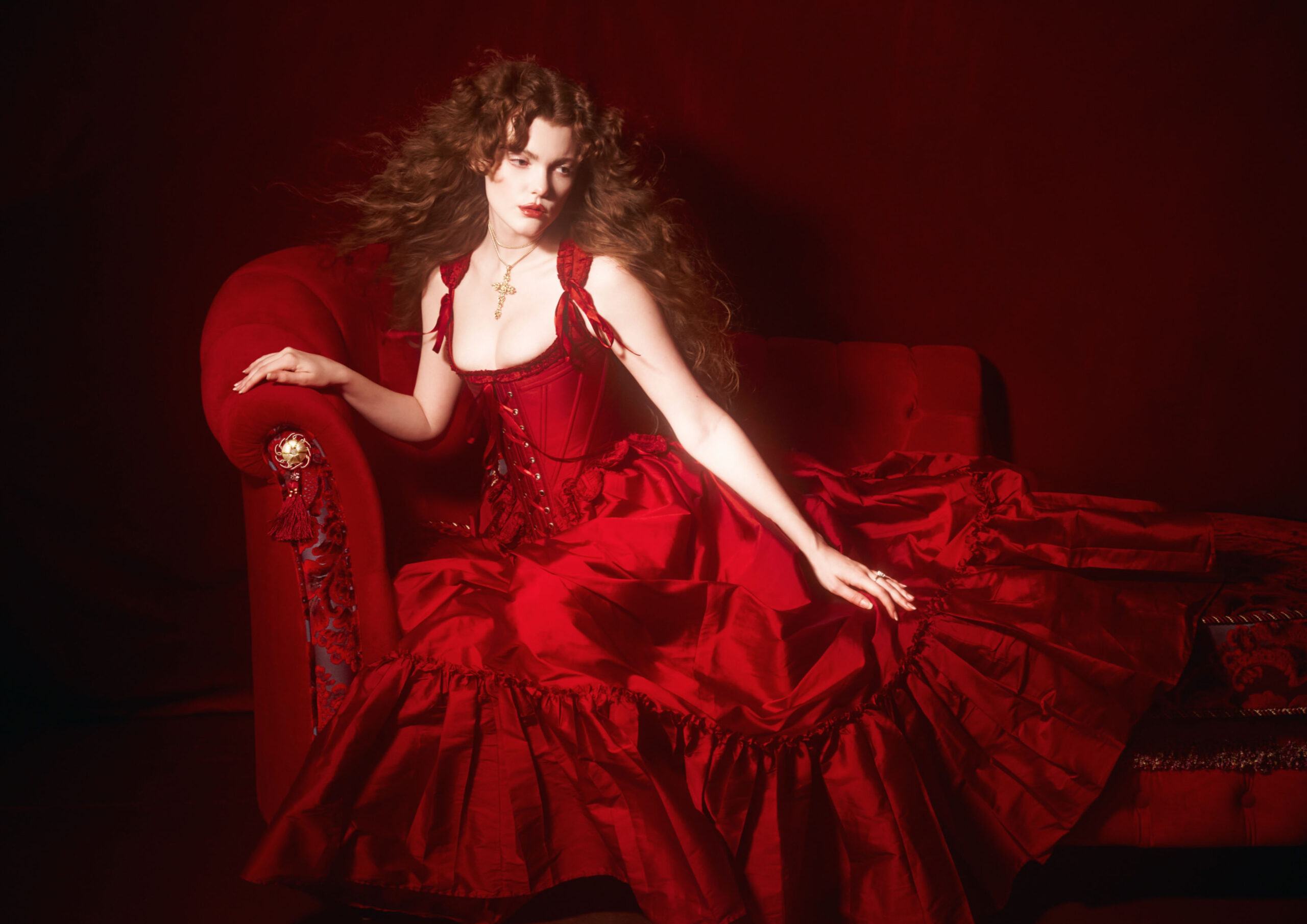
From the magic of the natural world to the trauma of human relations, the thread that stitches these disparate worlds is that of music. A commonality that permeates and transgresses every emotion, curiosity, and artistic endeavour, as Atlanta-based independent artist Saint Avangeline explores throughout her music and art.
Hi and thanks for taking the time out to speak with us at Musicology.
Your meteoric rise has been staggering, and given how successful you have become and the wide recognition your work has received, has this altered the way you approach your craft in any way?
I would say yes and no. The way I approach writing and singing hasn’t changed for me – I still pull my lyrics from the same sources and, for some reason, I cannot stop recording with cheap headphones plugged into my laptop. My favorite place to make music is still in my bed, surrounded by my cats and worldly comforts. However, due to my music reaching more people, it has granted me the opportunity to collaborate with others, something I wasn’t used to doing initially! It’s been really cool to work on tracks in real time with other musicians and have more creative freedom over the final sound, rather than solely working with pre-made tracks online, where I got my start. It has forced me to use a different part of my brain to be creative, and I think that’s so cool! I love learning how others create.
What were some of your earliest musical memories, and can you share the course of events that unfolded that led to your career in music?
My earliest musical memory was as a tiny little girl, around 4 or 5. I got lost wandering around at a family reunion and found myself on a restaurant patio, surrounded by trees filled with birds. I remember feeling like the entire world was filled with their singing, and I wanted to sing with them. I made up my own little tune to join in their music. It felt so magical, especially because of how shy I was about people hearing me sing. I wasn’t nervous that day because I sang for the birds. I have many lovely musical memories from growing up as a classically trained musician. I started playing the clarinet in the 4th grade, and most of my developmental years were marked by my passion for band!
As for the course of events that led me here, I would summarize it as a “luck born out of desperation.” I started making music for two reasons: I tried out acting, and I hated playing out someone else’s story, and I had a million feelings bubbling in my soul that desperately needed to get out. I had to emergency withdraw from college one semester into my freshman year after attempting to take my life, and I ended up having a lot of time on my hands after the fact. I wrote and recorded most of my album, Gardener of Eden, at this time. It took me two weeks from start to finish. It was my form of “talk” therapy. I had no idea it would randomly blow up years later!
Can you explain some of the events that have shaped the music you make, the lyrics you write, and the sentiments you try to explore?
Absolutely. Almost everything I’ve written thus far explores living with trauma and mental illness. My hit song, ‘Lilith’, was written about a sexual assault I experienced in my teens—it was my first song I ever wrote. I was writing a lot of poetry to cope with my trauma at the time, and I decided to try my shot at turning my poems into music. My first album dealt with themes of heartbreak and unresolved trauma around my parents’ unexpected and rather horrific divorce, trauma I’m still working through in my music and personal life. My sophomore album, Inferno, was written during my healing/grieving process following my breakup with an abusive ex-girlfriend. Each song represents a stage of grief I was in when creating it. All of my music is an intimate glimpse into my soul; a diary of sorts. I don’t enjoy surface level anything at all, and my art is no exception. I will always dive deep in both my art and in conversation.
Your work, especially in regard to film clips such as ‘Limerence’, is highly visually and laced with symbolism. Given its subject matter, did this feel like the right way to approach it when trying to express something that is difficult at best and borderline taboo at worst?
Oh yes, I definitely do. ‘Limerence’ was initially written as a love song, dedicated to an ex-partner I was dating at the time. Sonically and lyrically it drones on and on, chanting at times, as if I’m under a spell. It was written in a stream of consciousness, even the title, of which I didn’t fully grasp at the time. I was absolutely bewitched by them. My partner sucked the life out of me, and I begged for it. When I finally snapped out of my daze and left them, I heard the song for what it was; crying for help as I gave them everything. What better way to portray Limerence than with a vampire? The lilies in the video represent a lot for me as well. My name is Lily, like the flower, so it’s always been a motif for me! Lilies symbolize innocence and purity, two things that were taken from me, in addition to my sense of self. By the time I left them, I had no idea who I was anymore. The lines between my former and present self were blurred.
How has your sexuality and orientation influenced the way you express yourself creatively and the methods you use in order to convey the intangible?
I think it helps me greatly. I think for many queer people, there is this intense yearning that can all too often feel doomed or unrequited in a way that is so explicitly queer. I’d be lying if I said I don’t often worry that a love like mine might be “forbidden” again, especially in this polarizing climate, and so I love with all of my heart as much as I can. An inspiration of mine who conveys this level of yearning and despair is Tchaikousky. He was a queer composer, and I can feel it in his scores. There is a gentle restraint and an intense desperation in everything he has composed, and it cannot be understated. His composition explores both extremes. The stories he wrote or was inspired by when composing his music are all tragic in some way or another. Unrequited or doomed love was a constant theme in his work. I can only hope to achieve his level of tangible emotion through music someday.
The visual medium features heavily in all that you do, and what aspects of the medium do you feel overlap with music, and where do those elements diverge and operate in two very different spheres?
Both influence each other heavily. I’m a visual artist in addition to music, and I enjoy painting with words and sounds and visuals. I have chromesthesia, meaning I hear color, and everything I create is within a color palette in my mind. Basically, I also have a mood board in my head all the time, ready to go for everything I make. These elements mainly diverge where l don’t have the budget or capacity to make certain visual elements happen. That’s why I haven’t created many music videos yet; I need them to match my vision perfectly.
Where do you turn when seeking inspiration for your music, and what are the various sources that inform the right direction to take when working on the next project?
Oh, just about everywhere! I am deeply moved by this world and everything in it. I’ll cry at the most simple of things. I find beauty in the mundane every day. I would say that the place I pull from the most, however, is nostalgia.
I love to pull from the things that gave me butterflies as a kid- old anime I watched, original characters (OCs) I role-played online with, old video games and their soundtracks, all of the delights of the world only accessible through the lens of a child. I also pull lots of inspo from an old book of world poetry I found on a bookshelf somewhere years ago — half of the pages are highlighted at this point!
As for a source of direction, I look to the universe. It has never failed me. It always gives me a million signs and pulls me in the direction I’m meant to go.
Having spoken to and worked with a variety of different artists and musicians, during this time, have there been any words spoken to you that really resonated with you, which in turn altered the way you approach your music?
Absolutely, and I am so thankful for every single creative soul who has shared their heart and wisdom with me. The piece of advice I’ve been holding onto recently was given to me from Dave Eggar, whose wisdom and talent I could only scratch the surface of here. I’ve been very nervous about performing live for the first time and what’s expected of me, and his words soothed my soul.
“Make your show a party! Host the party that you would want to attend. Invite others in. Do what you need to do in order to be in your true element as an artist. Put a bed onstage if you have to!”
I liked that very much.
With your debut Mortal Genesis tour about to kick off in L.A before moving onto New York, are their elements of what you have seen (or not seen) on stage as a fan from performers that made you think about how you approach your own live sets?
Honesty, the main element I’ve seen in every live performance that I’m not too keen on is standing and moving around onstage… haha. I hate to admit it, but I’m not a very physically active or expressive person, especially publicly. I am a textbook introvert, very awkward and reserved, and the spotlight is something I tend to avoid. I recorded all of my music in my bed, alone in my house, with my door locked just in case. Additionally, I have the back pain of an old lady due to hyper-mobility, so I struggle to stand for long stretches of time. The challenge I’m facing has been trying to create a set and vibe that is visually appealing without having to fully sacrifice my comfort. Stay tuned!
What does music give you that nothing else does?
I’m sure this is the answer everyone gives, but music is my lifeline. I wouldn’t be here today without this outlet. It’s saved me on numerous occasions, and I’m sure it will again in the future. I have always struggled with expressing myself directly and literally, especially while dealing with my bipolar disorder. More often than not, music is the only way I’m able to process a lot of the complexities in my life in a healthy way. I remember telling my mom, “if I can’t make music, I will die,” and I meant that. My art is a reflection of my will to live, my sense of conviction, and it has manifested and created so much good in my life. I dream that my music can give others what creating it gives me; hope and stability.