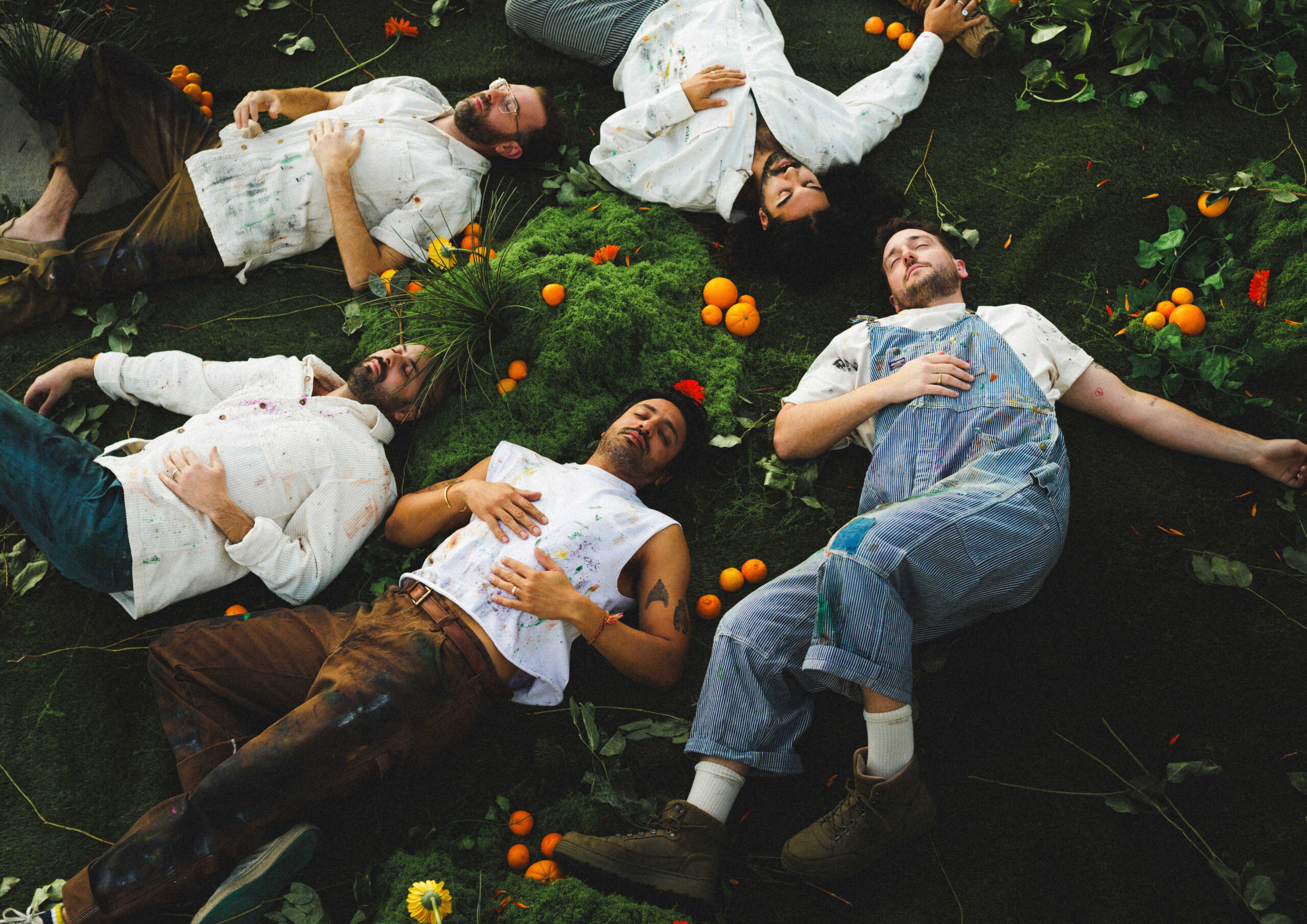
In a deeply divided world where mounting uncertainties are running rife, a pause, call for calm and time of reflection is needed more than ever. Cultivating radical empathy and optimism is at the heart of Victory Garden, the latest record by the multi-platinum Californian band, and vocalist Sameer Gadhia and guitarist Eric Cannata join us to discuss the album and its implications.
Hi Sameer and Eric, and thanks for taking the time to speak with us at Musicology.
As an outfit who have not only cemented their status as a musical powerhouse but also a band with a prolific rate of releases, Victory Garden places you in an elite circle whereby, having written and recorded so much material, tackling a new album means you can approach a record at an acute angle considering how much you have already explored over the years. What specific motifs did you want to canvas on this, your sixth studio record?
Sameer: That’s a great question. I think we’re taking little bits from every part. The first record was a shade of who we are, and with every record you create a new shade of that thing. This record, I think, creates it like everything is one full circle now, and that we’re drawing light to all the different parts of it. With American Bollywood having gone to that very specific angle, this is a record that is more about universal love and also just bringing back all of our techniques that we’ve learned throughout the earlier records. And we also had the intention of just wanting to get back to being in a room and live together again.
You have stated that the album focuses on empathy, and specifically, with regard to your single ‘Different Kind of Love’, that, in an overwhelming and persistent world of cynicism right now, love and hope are extreme forms of resistance. And indeed, it is harder to be kind than it is to be cruel, but did you ever expect that you would be compelled to make an anarchist, punk-style album in order to push back the tide of doubt and defeat the world is experiencing these days?
Eric: When we went to make this record, it was really about meeting each other where we were as a band, as friends. And it feels like the record that came out was what we needed, a reminder for ourselves about finding hope within ourselves and our community and our friendship. And it was also a bit of an intuitive or emotional letting go, and being able to move forward. I think that with empathy, and with the idea of radical empathy and Different Kind of Love, it isn’t easy to have the difficult conversations. It isn’t easy to find love for those who have completely different views to you. That’s the hardest thing. For us, what we do is we make music, what we do best and how we feel the most comfortable expressing our emotions is in that format, it’s in making music together. And whether it’s punk or rock and roll, or just by nature with what we do as a band, it’s what we find allows us to move forward in life and gets all of our emotions out. I think that it’s just a natural progression for us to have made this record. And seeing where the world is, we’re feeling what so many are feeling. We are pent up and we are upset and we are angry, but we don’t want to add anger and vitriol to the conversation. We want to add the best parts of ourselves. We want to add hope and we want to add joy and unconditional love to the conversation.
As the lineage between your earliest albums through to your upcoming, where do you feel the overlap across records lie, and where do they stand as distinct bodies of work?
Sameer: The first record was just where we were up until that point. And every record is a recording of where we are in our lives. We’ve seen and arced plot lines of records now only looking back, I think album three, four and five were these triplet sister records that lived in this world where you’re going through one consistent story that climaxes with American Bollywood. And this new record is drawing some wisdom from those records, but drawing some wisdom from the first and second and just taking it somewhere else.
The sonics you embrace and the varied incorporation of genres you employ throughout your music are indeed among your signature accents. Has it always been a case of simply seeking out the most suitable instrumentation to pair with the sentiment you are exposing, or more so a case of bringing to bear the current styles going round in order to carve out the sound you want to hear on your album?
Eric: That’s a great question too. I think that just by nature, we’re five people who have a through line of influences that we share, whether it’s music or anything really, art, books, movies, nature, whatever it may be. But when we’re creating, it really is to service the song. For us, the song’s the most important part. Just by nature, we’re exploratory. I think that we’re put into the genre of alternative rock, which is such a broad umbrella, the idea of “alternative”. But for us, “alternative” is that idea of trying to push our own boundaries sonically, songwriting-wise. It’s always just been a curiosity kind of thing. It’s like, “well, what if we mix these two things that might not have been mixed before, what would that sound like?”. Some of our most exploratory-sounding recordings tend to be songs where we may mix a few elements that we’ve never really heard mixed before. And just by our curiosity, we try things out. And that might influence a vocal or a lyric, or it might influence another part of the instrumentation. For us, we kind of oscillate between: let’s try something that we’ve never tried before sonically and maybe that will influence a song or influence a particular direction while also really feeling at home and great with this kind of more traditional instrumentation that we started out with, two guitar players, a bass player, a singer, and a drummer. We kind of go between those and mix and match and try different things to really honour the songs. This particular record was a lot about us getting back to being a band, but that didn’t stop the experimentation from pulsing synth basses to drum machines to layering guitars and guitars and guitars, and vocal effects. It’s really to honor the songs, but also we want to explore and experiment and enjoy the process of being creative together.
Your writing process is a collective one, to say the least, as the band will often come together for intensive writing sessions that result in a unified event, not simply one or two members of the band sharing all the writing responsibilities. How has this benefited the work you produce, and how has it been refined, made more efficient and more emotive over the years?
Sameer: It’s very varied, it’s like a spectrum of ways. And because we’ve done six records, it’s kind of been all over the place. In this particular way that we’ve done it, Young The Giant songs are when only all five of us are in the room, because the way that the five of us combine is what makes Young The Giant. And I think that’s proven to be true on this record. There are times in the past where we’ve done it in different ways, but this felt like the right thing to do right now.
There was some real heft in the studio you chose to work in, the Henson studio in Hollywood and guided by the steady hand of Brendan O’Brien of Bruce Springsteen, Pearl Jam and Soundgarden fame. What characteristic fingerprints did Brendan impart on the album that bore his touch?
Eric: What brought us to Brendan was his ability to capture energy between a band, and the amazing records he’s done over the years have been a big influence on us as a band, including The Rising by Bruce Springsteen. Personality-wise, he was really able to get us out of our heads and get the ball moving, and the momentum in the studio and working in Henson [Studio] allowed for that as well. It’s an incredible studio where everything works and everything was flowing and we were all moving in a forward momentum. But also his knowledge and ability to get things to sound incredible quickly is really just magic. When we went in to record the first song, which was Evergreen, Sameer went into the vocal booth and started singing. This is Sameer’s vocal sound on the entire record, I think he mostly used that exact microphone, that exact compressor. Everything that Brendan had set up was already dialled so perfectly that it was just seamless and easy. And that just comes with years of experience. I mean, Brendan’s in his 60s now, he’s done so many incredible records. As a band on our sixth record, it was important for us to have someone who we really could put our trust into and someone who could get us out of our heads. Brendan really did a good job at that.
You have performed around the world so many times over the years, can you share with us one of your particular favourite shows and what made it so memorable?
Sameer: I feel like it has to be one from Australia.
Eric: Splendour in the Grass was sick back in the day.
Sameer: Splendour was great. I was actually going to say when we did Rod Laver Arena in Melbourne where they do the Australian Open. I grew up watching tennis and that was one of those bucket list moments to be able to play a venue like that.
Eric: For me if we’re talking Australia, Splendour was a blast. Also, it’s maybe not the best example, but at the time Kanye was touring on My Beautiful Dark Twisted Fantasy and that was a spectacle for sure at Splendour. And I just remember enjoying the festival overall. I think the first time we went to Australia, was it with Group Love? I feel like we did a short tour. What was that same tour?
Sameer: Yeah, that was that same tour. And also, the only ever shirtless photo that was ever taken of me was taken in Australia somewhere. I don’t know why, but they asked me to take off my shirt. That’s so funny, that was a fun trip.
Having shared the stage with so many amazing acts such as Bloc Party, Cold War Kids, The Lumineers, The Beach Boys, Foo Fighters and Kings of Leon, to name but a tiny few. During this time, have any words of wisdom been spoken to you that really resonated with you, which in turn altered the way you approached your craft?
Sameer: The first-ever tour in the States that we did was with Minus the Bear. We were a baby band, they took us out, gave us some marketing money and everyone was a little bit dubious of us because they were all homies in their mid 30s or early 30s, they’d been playing shows together for years and years, and we’re this band, we’re 19 and super green. But we earned their respect throughout the course of the tour. And I remember Russ Pollard, the singer of the group Everest who was playing direct support, he was like, “you have this voice, don’t try to change it. Be the truest version of your voice”. And he was like, “you have a pretty-sounding voice”. It’s also a lot to do with the masculinity that’s involved within the alternative rock space, but I think in between the lines was like, “people might think your voice is too pretty, but you just be you and embrace that voice that you have because that’s the thing that gives light”. And taking that forward, I’m just allowing my voice to do its thing.
Eric: I have a small one, but it’s not one from when we were on tour. We toured with Incubus, but there was an interview with Brandon Boyd that I watched years later on YouTube, where he was talking to a manager or one of the previous team members. The question was, “do you have any advice for younger bands?”, and he was just like, “keep your weird.” And I always liked that. I always liked that idea of “keep your weird”. There’s also a great Bowie quote as well that’s in that vein that’s something along the lines of “never forget why you started doing this thing”. We started doing this because we wanted to make weird sounds and make weird songs and hang out and make music together. And it’s important not to lose sight of that.
On something of a philosophical note and a concept we routinely explore at Musicology, what does music give you that nothing else does?
Eric: It gives me an outlet of expression that makes me feel free and like my fullest self. It’s an outlet of expression to express my fullest being and deepest self.
Sameer: It is the closest thing to a spiritual experience you can have. Writing or performing, making the act of music allows you to be in the present moment and that is a gift.