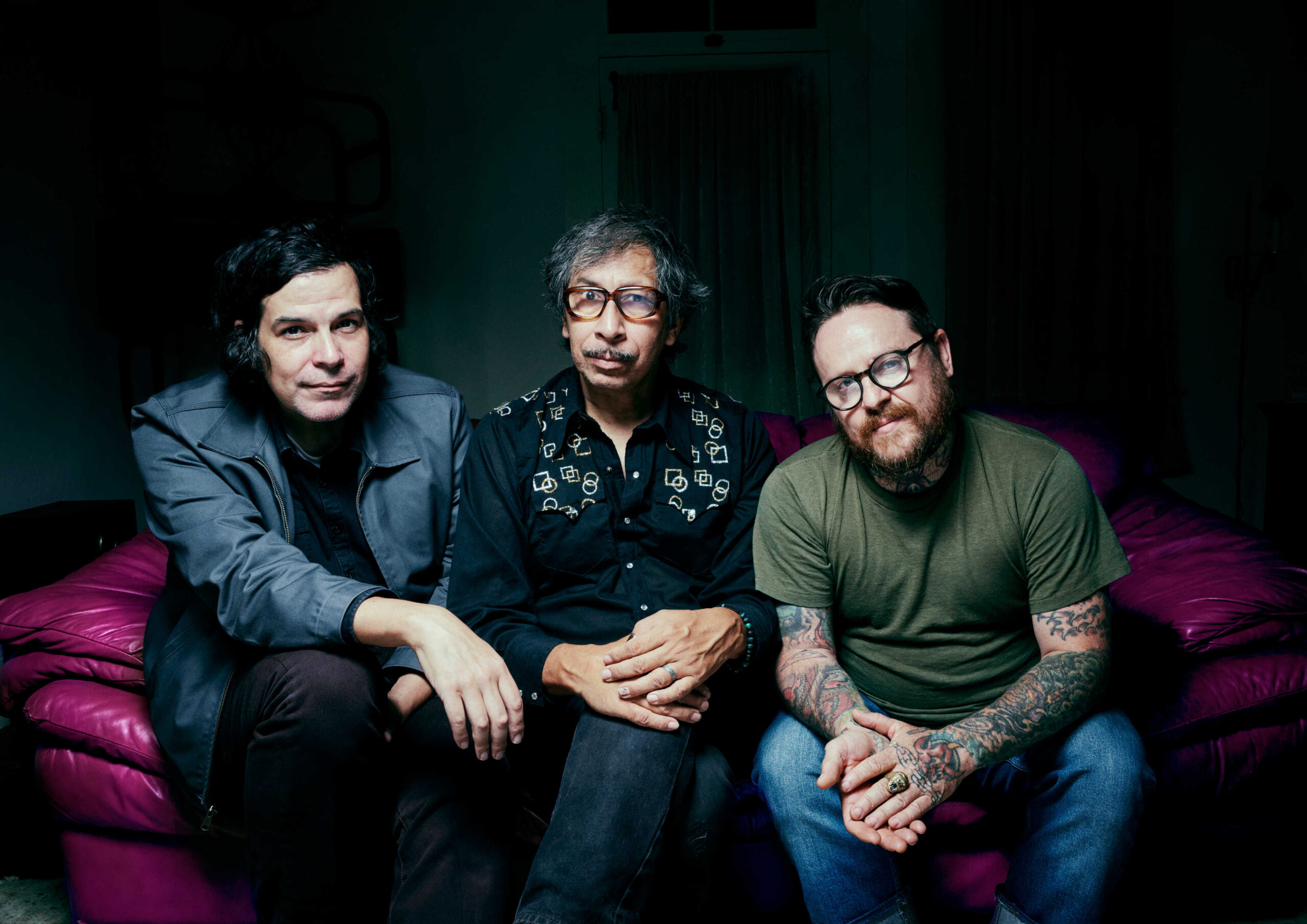
Some artists need little introduction as their reputation precedes them. Brian Tristan is one such man, and the mere rundown of his impressive rock and roll resume would intimidate any average mortal. Member of The Gun Club, The Cramps and Nick Cave and the Bad Seeds. He has also played with the Divine Horsemen, the Angels of Light, Die Haut, and Knoxville Girls. All this before even considering the voluminous work produced by his most enduring band, Kid Congo and the Pink Monkey Birds.
Blasting into the scene with legendary The Gun Club, it was his relationship with founding member Jeffrey Lee Pierce that would leave a lasting impression on the young Tristan that ultimately changed the trajectory of his life. The man who encouraged and taught Tristan how to play the guitar was rewarded handsomely, not just in musical terms but with an enthusiasm and passion that matched, if not exceeded, his own. This, in turn, precipitated an ongoing relationship that spilt over into the iconic Cramps. Participating in five seminal records between the two outfits, records such as Psychedelic Jungle and Mother Juno simply speak for themselves and are regularly cited by fans and artists alike as albums that denote a high-water mark in the punk, rock, and goth scenes.
Adding to the legendary list of liner notes, Tristan’s contribution to multiple Bad Seeds albums only cemented his credibility and ability to be at the right place at the right time. Featuring on Tender Prey and The Good Son, such appearances propelled Tristan onto what would become his most long-term and definitive work, The Pink Monkey Birds.
On a spectrum between youthful and innovative music through to experienced and confident musicianship, Tristan, with his extensive and expansive career, has spanned the entire distance. He is therefore uniquely positioned to sufficiently answer the ponderous question as to what the fundamental difference is between how he created music in the earlier days and how he creates music nowadays. “A lot of the earlier work, I was just starting to play guitar, and most of the time was trying to keep up with what was going on with those musicians! And trying to fit into their visions of the music, in the case of The Cramps and the Bad Seeds. It was like going to school and hoping I’d pass the exam. A lot of that was experimental, and I was cast as a sort of noisy or atmosphere guitar player rather than a muso. So that is the way I had learned to make music.” Quite an honest assessment of what must have been a baptism of fire. Intimidating though it must have been, serving such powerhouse acts, and the time spent in each sharpens the mind and hardens the resolve. Honing his skills and forging ahead, it was during these times and steep learning curves that Tristan established himself. Fast forward to the present, and it is with certainty and assertiveness that Tristan states, “Nowadays I trust myself a lot more. Still rudimentary, but I have carved out my niche in playing and love it. Still learning and I am grateful for that.”
Having now spent more time in the Pink Monkey Birds than he has spent without them, it might be fair to say that the Pink Monkey Birds are the musical project that defines him the most. An agreeable notion, according to Tristan. “It is my most constant band. Needs little to no real plan. It has become a beast of its own. I am not fond of being defined, and I like to be open to try all kinds of music and collaborate with different people. As a body of work, I am enormously proud of the work, and it is certainly an accomplishment by us all involved.” That freedom to explore sound and to be completely unfettered in the creative process only adds weight to the argument that a no-holds-barred approach encourages longevity for a band. Particularly so when considering the autonomous nature of the Pink Monkey Birds members (Ron Miller on drums, and guitarist Mark Cisneros), and instead of playing under fellow bandmates as Tristan had done in previous outfits, he now plays along with them on an equal footing.
Evidence of that freeform style can be found on the latest Pink Money Birds record That Delicious Vice. Not just in how the band creates but also in who they create with. Stripping down to a trio, shredding a quarter of the creative input, puts into question what sources of inspiration Tristan and the others drew upon for the new record. Where do the lines of their general creative methodology intersect, and where do they diverge? “As I just mentioned, there is little planning. We rarely see each other, and so get together with different ideas by the different members. One thing was that we have become a trio and wanted to make a record as a three-piece band. Also, we invited the singer Alice Bag to guest on a song or two. She came with a song called “Wicked World” that we collaborated on. We had not worked together before, despite being friendly since the earliest days of punk in Los Angeles. I admire her work and writing, and was thrilled she agreed to come and participate. It was fun, and she sang backing vocals on a few other songs! So those were different elements than usual.” Proving that there are still plenty of untapped creative goldmines out there whose rich and generous seams of collaborative wealth are yet to be raised to the surface for common consumption, Tristan continues to work with artists both from the present and the past.
The extensive network of friends, creatives, musicians, and artists Tristan has met and amassed over the years can best be summed up by ‘Some New Kind of Kick’, his recently published memoir. It cannot be overstated how impactful the bands Tristan has belonged to have been on him and how, along with his influence within these bands, they have in turn influenced the course of music. “I have written a book that extensively talks about these memories of all the bands. They were wild and woolly times with a drive to have and create an intense and indelible experience for both us and the audience. I will say all three bands (The Gun Club, then The Cramps and Nick Cave and The Bad Seeds) were successful at that. And to create and execute original and different music. Thus, a new language. That finds us back at communication. What I learned from all three of them was to hang on and defend the original vision, because all three bands had strong visions of their magic. So, to not bow to what is expected from the music industry (record labels, press etc) or public at large. Even to ourselves! It has proven a worthwhile philosophy I employ today.” When a wise man speaks, one must listen, and distilling a lifetime’s worth of experiences into tangible lessons is like a wormhole between the here and now, past, and future.
It must be recognised that to break through, to really make a mark, and ultimately reach a goal, it takes a certain drive that often blurs the line between extreme selfishness and unwavering commitment. Something that not all folks can sustain or have the opportunity to follow through with. It takes young blood and firepower to push through a king tide, so it would be fair to say that Tristan’s internal fire has been consistently alight and applied equally across all of his pursuits, including visual media, fashion, music, and film. “Well, I certainly have done as I well damn pleased in all those areas, so I may agree with your assessment. I have not always hit the mark, but overall, I have followed gut instinct more than rationality. This has made good and bad results. But it’s what I have chosen to be the best way for myself.”
It is customary in an autobiography that it be replete with highs and lows. Given the 20/20 vision and clarity that hindsight affords, looking back over his career, there are, of course choices that Tristan wishes he had made differently. “First thing that springs to mind was wasting all that time being a junkie. But that had lessons that brought me to my present state of 24-hour reality for the past 26 years, which are valuable hours. But a lot of wasted unproductive hours are regretted, contemplating the abyss when I could have been having fun. But in my career, I would change nothing. It was a miraculous time.”
As with any book, however, there is as much left out of the final cut as there is that went into it. Not all tales, thoughts, and experiences can find their place between the covers. It is always interesting to know what was cut and why, as Tristan explains. “Certainly, there were things left out because they were superfluous to the main story. The editing process can sometimes be brutal. I wish I could have written more about the AIDS crisis of the 80’s and 90’s. Or more, the people I knew in music who died during that awful time. I do address it with a story of a young couple, Travis, and Mark, navigating their impossible circumstance, and its effect on me as their friend. Perhaps that is a whole other book.” One’s overall musical influence, however, is derived from many different constituent parts. One fundamental aspect for Tristan is that of his American / Mexican heritage, how it shaped the direction of his life story, and its continued effect over time. “My Chicano heritage shaped my life story by never fully being accepted by white American culture, no matter how assimilated I grew up. I was always “other”. When punk rock came about in the 70s and being “other” was a requirement, my Mexican heritage and being Queer worked in my favour. Still, I did not lean into those aspects because labels were taboo. A catch-22. As I grew older and started to explore what I loved about my upbringing, musically and personally, Mexican American culture really started to sing to me. Roots became important to understand myself and my family.” A sentiment that broadly speaks to millions of people, but equally, it is idiosyncratic and uniquely personal to Tristan alone, as he can attest.
When considering the most enduring legacy that he has imparted to those closest to him, those in his musical circle, and to his fans from around the globe, what for Tristan is it that stands out? In a few words, quite simply, “A good time”. Yet to elaborate and be a little more precise, Tristan says. “A sense of the absurd and flights of fantasy are good things I’ve done in music. And a connection with the audience and the people involved in making the music. Both personally, on stage, and on recordings. That is important to me.” From the lighter notions to the deeper ones when posed a philosophical one asking, what does music give you that nothing else does? In Tristan’s infinite wisdom, the reply came back “hope”. A resonating statement with beckoning curiosity, how has that hope continued to help both personally and professionally? “It’s not something I think about normally. When I say that music gives me hope, it is that I look for answers in music. Mostly a mood rather than a lyrical message. It is a communication that is mysterious but somehow understandable. Makes me see that I am alive.” There is honesty and humility with all that Tristan talks about, and that alone could be the single greatest asset anyone can have. A steadfast belief in self and that a given course is the right one, even if the path is a winding and at times confusing one.
The final question, however, must be, where to from here? What does Tristan envisage for the rest of his musical career and, in a wider existential sense, his life? In many ways, it couldn’t be clearer. A ready-made answer and a motto to live by. “I envision I will be playing music for the rest of my life. And enjoying myself, my partner, friends, and cats. What is more existential than being obsessed with cats? It’s an endless fascination.”