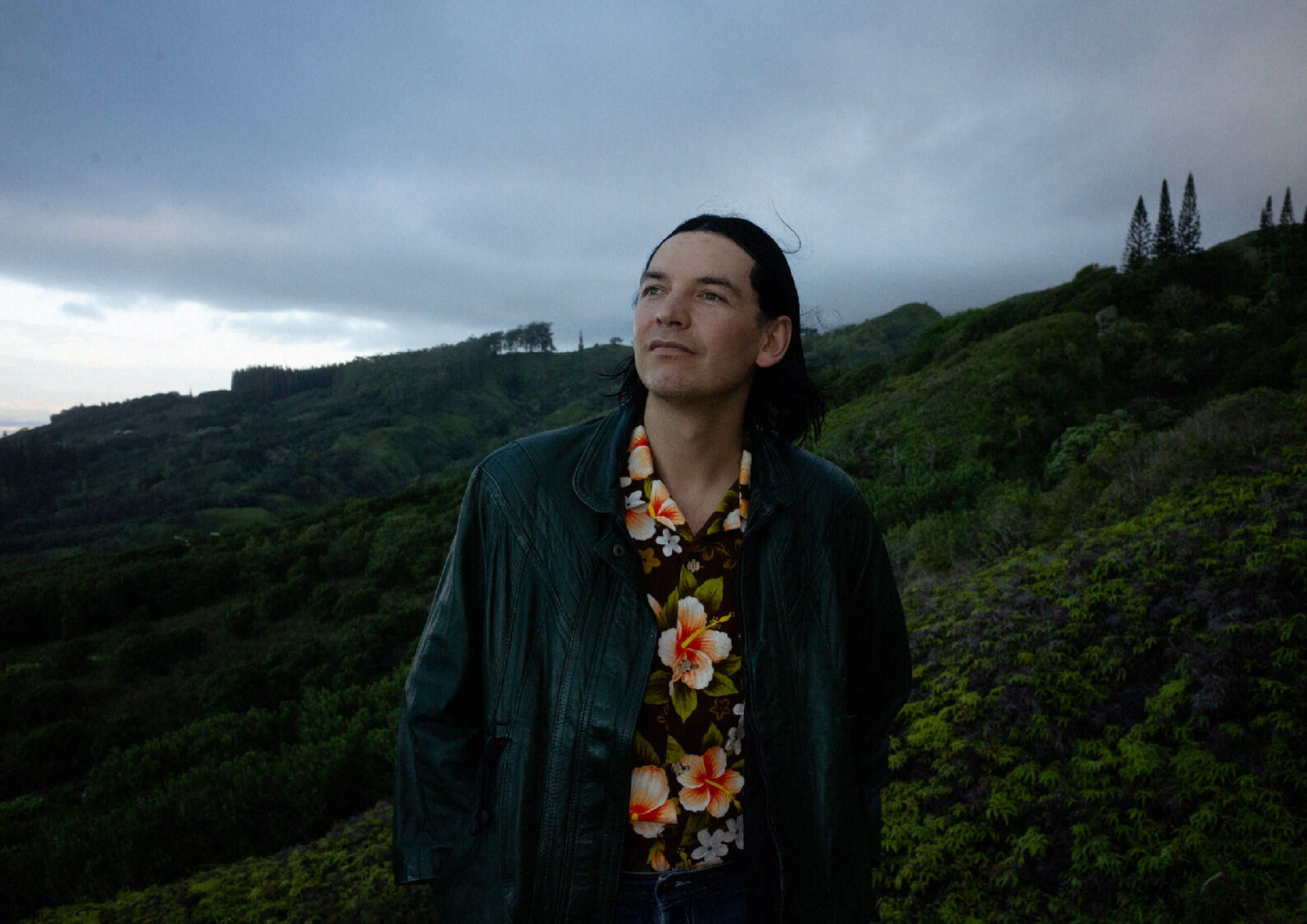
When you are in the middle of nowhere, you are halfway to somewhere. For Gus Englehorn who has spent his life living between vast geographical regions and who has spent a great deal of time pursuing different disciplines, there is a place where worlds merge and paths cross. A blending of wildly disparate lines of thought, that at face value appear to have little in common, are underpinned by a creative foundation that unites one and all. The freedom to explore, design, create and collaborate, all coalesce to form an approach that is applied to life and life’s pursuits.
Hi Gus and thank you for taking the time out to speak with us at Musicology.
Given your previous works Death & Transfiguration, and Dungeon Master, what fundamentals were you looking to keep and what new sonics were you hoping to explore?
It took me so long to write the first record that by the time I got around to recording it I was terrified that I would mess it up with the production. So we practiced a lot of restraint when it came to the arrangements and that loosened up a little bit on Dungeon Master and by the time we got to The Hornbook, playing the studio felt like the irresistible forbidden fruit that we just couldn’t resist anymore. We really broadened our horizons and started messing with stuff a lot more.
You have described your songwriting approach for this album as akin to a child’s book with every track a little story. Did this method make the process easier or at very least something of a novel experience and therefore simpler to produce from start and finish?
There isn’t much method involved in my writing. It’s more of a constant poking around in the dark until I make little discoveries that feel exciting to me. It’s always around three quarters of the way through writing a record that I start identifying themes and meanings. And when I understand the common thread that stitches the album together, it feels done.
Occupying a fictional realm can at times make it easier to broach bigger and deeper subject matter. What range of personal and interpersonal topics did you canvas throughout the record?
It sure can! I don’t seem to be able to approach anything head on. But sure enough, I’ll get done writing some twisted little tale that I was sure had nothing to do with my day to day life but then on closer examination, there’s always a bit of reality in there. You can’t escape it! My dad’s name is Roderick, my brother was in the New York Times for metal detecting, and I get a lot of rashes.
Working with long-time collaborator and wife Estée Preda, in what ways did your interconnected dynamic influence the course of The Hornbook?
I’m constantly showing Estée half finished songs I’m working on and she’s incredibly patient with me. I’m sure when I’m on my death bed I’ll be saying: ‘’Hey Estée, does this bridge work?’’.
Having Mark Lawson of Arcade Fire, and Timber Timbre fame co-produce the album, what fingerprints did he leave on the record that you feel without his contribution wouldn’t exist?
So many fingerprints. He actually changed the whole way I look at producing records because he has such a wonderful open-minded approach and he is always willing to try any idea out. And he taught me about the power of collaboration, you know just getting some good musicians in the studio and letting them try out things and see what sticks. It’s definitely something I will do from now on.
What was it about the renowned German artist Angela Dalinger that drew you to her work and made you seek her out to work on the album cover art?
The combination of humor and darkness. When we asked her to do the cover, I sent her the song Roderick and asked if she could make it based on the lyrics. She seemed very intrigued and asked me a string of questions such as ‘’May I paint the blood river?’’ and ‘’Does the armor have to be historically accurate?’’.
Performing with so many different artists, working collaboratively in different media and looking towards those operating in a whole other creative sphere. Has there been any words of wisdom uttered to you that really resonated with you which in turn altered the way you approach your craft?
‘’Do the opposite!’’ That’s another one from Mark. Also, fear over criticism limits creativity. Do not fear, fear is the mind killer. Okay, that last part is from Dune.
Your current vocation is in the music realm but during your formative years it was skate and snowboarding that dominated your time. Looking back at those checkpoints in your life, have you been able to identify those key moments that proved to be truly transformative?
Within the art world, creativity floats a lot closer to the surface and everyone is interested in tapping into it. It’s the name of game. In snowboarding and skateboarding, you’re working in a realm that is half sport half art. And I don’t think I knew I was interested in it purely for the creative possibilities for a long time. But once I understood that, I understood myself a lot better and now I know that the reason I do just about anything is just to have an excuse to use my imagination.
Growing up between quite disparate locations and splitting your time between that of Alaska and Hawaii, did the geographical dichotomy shape your outlook and the way you perceived the world given how very different the locations and lifestyles can be?
Most certainly! I think a lot of Alaskans and Hawaiians feel like outsiders because geographically we are. And I always feel like I’ve fit in that category pretty neatly. Strangely enough, there’s a lot of similarities between the two places.
Currently residing in Montreal, Canada, how is it shaping your music and the trajectory it is taking?
Living in a place where artists were seen as important members of society and even supported by the grant system, had a huge effect on me. I met all these wonderful people that helped me understand what it meant to live as an artist does. I was always just a country bumpkin looking in from the outside before and after I moved to Montreal I found myself smack dab in the middle of it.
Also it’s a fashion center and I’ve always loved fashion. But where I grew up in Alaska and Hawaii, I had to be pretty brave to exercise my creativity when it came to my outfits. But I couldn’t help it and I would dress like David Bowie at school and stick out like a sore thumb. So when I got to Montreal, it felt good to be around other people wearing crazy clothes who liked underground culture and I felt, for the first time, that I had really found a community that reflected my interests. But I don’t live there anymore! I moved to Maui six months ago. It nice to be hanging out in the jungle, eating bananas and playing the guitar under the guava trees.
What does music give you that nothing else does?
A lot of grief and peace at the same time. A rare combo.