BLACK VIIOLET
SIREN SONG
“My music is my spouse, my child, my parent, my best friend, my therapist, my banker, my whole world. I have never had a relationship with anyone or anything that comes anywhere close to the joys that music has brought me.”
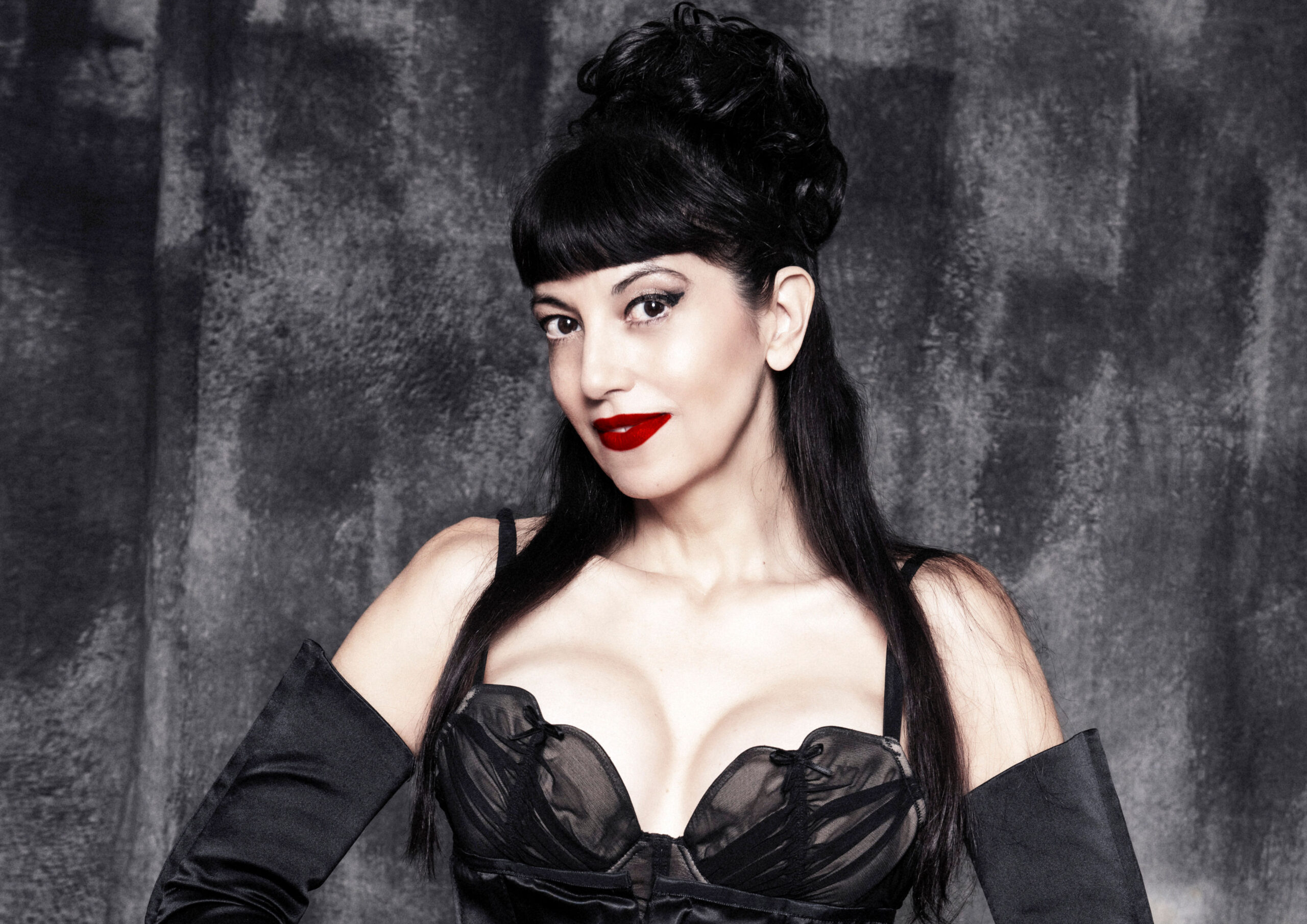
Ladies & gentlemen. the jazz-soaked, smoky sounds of Seattle’s sultry siren of the night….Miss Black Viiolet
Hi Nicole and thanks for speaking with us at Musicology.
Having honed your musical skills with The Darts, your solo work takes a different turn. Is this project something that has always lurked within and only now being able to see the light of day or a product of your time on the road and extensive experiences?
I grew up playing classical piano, even competing at a young age, and then dabbled in jazz trios long before I ever discovered the joys of garage rock. When I am not on tour, I listen to a lot of downtempo kinds of triphop and pop, jazz and quieter things. So Black Viiolet presents really a lot more of “me” than any other project I have done before. I am writing just for myself, really, to make music that I personally might choose to listen to, as opposed to writing for someone else’s ear. I absolutely have grown to love the garage-punk world, don’t get me wrong, but I was sort of invited into it when The Love Me Nots were formed, rather than creating something from my own head and heart. The road and the many life experiences I’ve had up to this point have definitely given me material to write about, but the years have also given me a confidence I always lacked; I never ever had the guts to step forward with something completely of my own making before this. It took time to develop that voice and courage.
In what ways has the Seattle scene shaped your music and the course of Black Viiolet?
My move to Seattle has really opened my eyes to the massive talent up here in the Pacific North West. Everyone is in a band, or a visual artist, or a photographer, something artistic, and they all play in each other’s bands and go to each other’s shows. The community feels really supportive and positive compared to a lot of other cities I have been to where bands compete and fight and fuss. You can go to a little jazz club on a Wednesday night and there will be four people in the audience and every member of the band on stage is literally famous, just playing there while they are off tour, for free. It’s crazy. I did that exact thing and met of all people Conrad Real, the drummer for Digable Planets (one of my big early influences for Black Viiolet bass lines and horns) and now he is on one of my records. Everyone here has jumped on board when I have needed musicians, or rehearsal spaces, and they are so enthusiastic about this new project – I played at Easy Street Records for example, and people were coming in off the street and filling the place up, when the project first started. They genuinely love good music here, all genres, and it makes me feel like I can do anything. Honestly, it’s so refreshing in a usually-jaded USA music market.
Is there an overarching theme to the Dark Blue album, or very much a collection of standalone pieces, each addressing its own topics and sentiments?
There is a theme, actually. I didn’t realize it as I was writing it, because I was living it at the time. But the album really does trace the arc of a new relationship – albeit an ill-fated one – and the titles really reflect that in hindsight.. it literally goes from “Just Met” to “Bye” ! The struggles with managing huge tour schedules with an already-long-distance relationship led to a lot of emotion, and music is always my therapy. My agent says he can tell what’s going on in my life by reading my lyrics, they are kind of a diary of sorts. I find that writing from your own experiences, about all the little specific things that happen to you, really speaks to a lot of people in the end.
Lyrically, how much of what you wrote for the record was cathartic, and how much was confession?
Aren’t all confessions cathartic? Or at least I think that is how they should feel, once you heal from the vulnerability of the disclosure, anyway. My lyrics are always a catharsis for me. I don’t know that you will find any earth-shaking confessions on this album, more like honest thoughts about what is happening and what I wish was happening. I hope that listening to these kinds of words reaches someone else who can relate to this and make them feel validated and understood. People often cry at our live shows, and I think this is why; the depth of the sound combined with a very personal lyric can change the way you look at things in your life. After one recent show, a very young woman came to me and said, “your music sounds like what it feels like to be a woman” and that was a very powerful compliment to me.
What do you feel that can only be expressed through jazz that other genres can’t quite translate?
A lot of the jazz I listen to has no vocals at all. The sound of an instrument meandering around quietly, rolling around inside a chord or scale, grabbing onto a hook and then massaging it into something new and unexpected..to me, that’s what jazz offers. It is at once peaceful for my mind and also challenging, and not many things do both for me in my life. I can’t say that Black Viiolet is exactly jazz of course, but the way the horns intertwine with each other, the way the bass climbs around, and the wandering keyboard lines try to evoke some of that feeling. But I try to add a pop structure and sensibility so that the listener has a strong hook and message to grab onto, to make the whole thing a little more accessible and timeless and genre-less maybe.
With any jazz outfit, there is a huge degree of free-form play. Can you describe your relationship and the interplay you have with the band in order to produce your signature sound?
To be honest, there is little free-form play in the traditional jazz sense on a Black Viiolet record or at a live show. A lot of jazz involves playing a head, and then the band members take turns improvising on it. That is not at all how my songs work. My songs are structured pretty much always the same way – intro, verse 1, chorus, verse 2, chorus, solo/bridge, chorus. I find that structure to be deeply satisfying and keeps bringing the listener back to a memorable hook or phrase to drive it home. But within that solo section, or when I present a bass line to Evan, or when I tell the horn players to “make this part sound baroque” or something, they bring the jazz to the table. They are excellent at running with my ideas and adding their own interpretations, but never stepping on the hook or straying too far from the pop sense of the songs. I think that’s what makes this project so unique – it blends a lot of influences and talents.
Furthermore, in true jazz fashion, the album featured a great many contributing musicians from around the world who added their own input and unique touches. Were their relative disparity and localised style a big factor in what gives Dark Blue its je ne sais quoi?
Absolutely. Since the inception of this project, I have tried to incorporate local musicians into the live shows. If we played in Europe, we had a European horn section, and if we played in the Midwest USA, we had an Ohio drummer, for example. It made for a couple of years of fascinating touring and sounds, but it was also a lot of work and unpredictability for all of us to do it that way. (For 2026, as the band has now started to grow up a little and the audience expectations are also growing, I have decided to have a set touring roster.) But bringing on board not only an entire horn section of top-level jazz musicians from France, on top of a US rhythm section, plus sprinkling in vocals from punk legend Blag Dahlia (The Dwarves) and pop-punk star Jason Devore (Authority Zero), and then ending the record with the massive gorgeous string section created by Deovtchka’s Tom Hagerman – there is no substitute for the genius and talent they all brought to the project. Everyone had their own take on it. In fact, I gave our guest musicians very little, if any direction, and they just created what they heard for it. What a huge, indescribable gift, to hear their ideas blend with mine. It really does make the album even broader in range and genre.
What has been one of the steepest learning curves in transitioning between your earlier works and garage-punk style to that of the jazz noir, trip hop blend that you find yourself now playing?
Playing live with backing tracks, so that we have those trip hop beats and strings and other nuances underneath the live band, has been a real learning experience. Stylistically, having the courage to bring the vocals to the front, rather than screaming above a wall of fuzz, has been both terrifying and rewarding. I have had to learn to trust my ability to play a jazzier style of piano, while surrounded by jazz experts. But really, the biggest change is how I sing. I have learned to work the microphone and effects so that the vocals really float above everything and stay soft and personal at all times, even when the band is cooking. That wasn’t easy.
During your many years of performing, have there been any words of wisdom spoken to you that really resonated with you, which in turn altered the way you approach your craft?
From a songwriting perspective, the old expression “don’t bore us, get to the chorus” shaped things early for me. Create a hook or a phrase that the listener will not only remember but might also want to sing along with; try to make them laugh or cry with your words. From a performance standpoint, don’t be afraid to really interact and get personal with the audience. People come to a show for a different experience than listening to the record. I love going to a show where I come away feeling like I really know that artist so much better as a person. My shows in any genre are personal for me; I spend a lot of time singing directly to specific people in the audience, as it helps my delivery. I spend time explaining the songs – even in other languages using my phone translator! – because I want them all to feel the music on a mental level, not just on an audiovisual level. I spend a lot of time at the merch table before and after shows, meeting everyone and talking, so that they know I am grateful for their time and attention, that I could not have this life without them. Leave any entitlement and arrogance out of your life and make everyone part of the show.