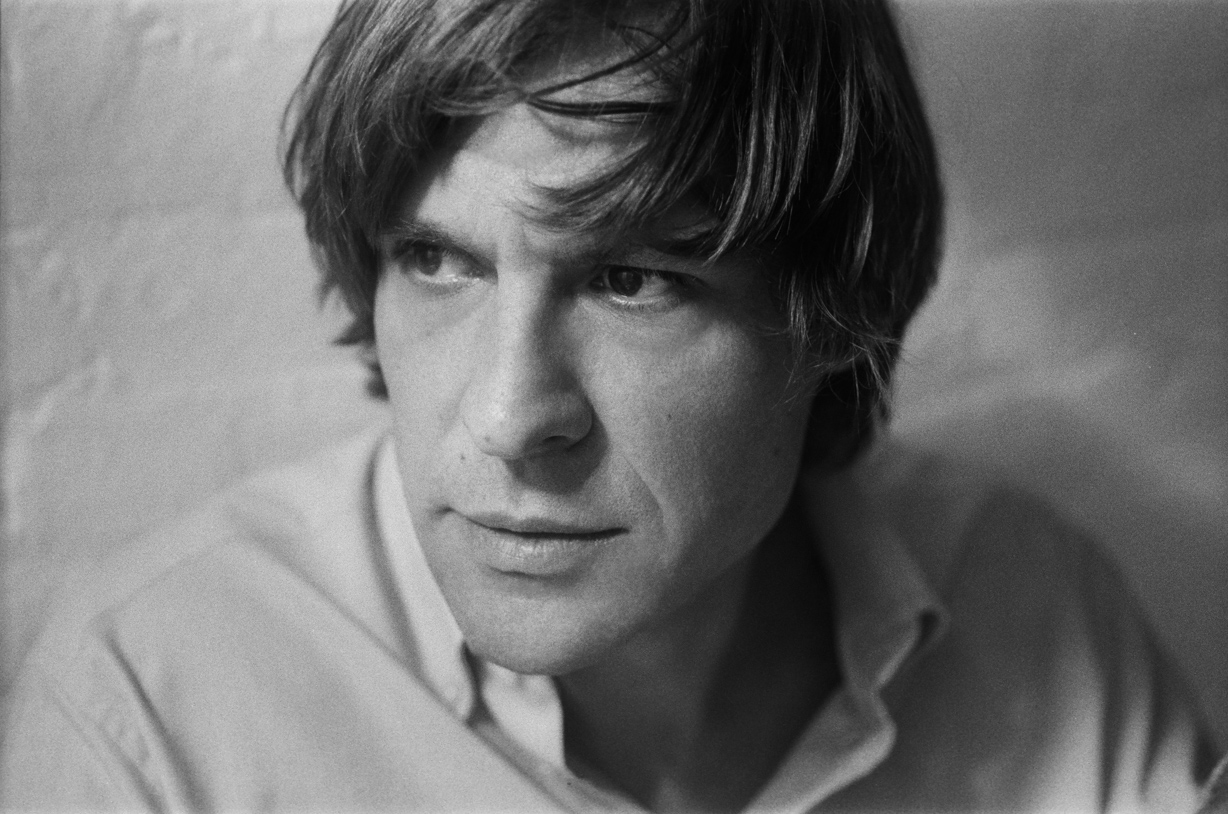
A philosophising experimentalist, whose compositions embrace the full width and breadth of the musical spectrum. His latest release, is a digital degustation of death, grief, and spirituality.
“Hey, listen to this!”. A simple suggestion from music-obsessed friends can often lead to thought-provoking and paradigm-shifting moments that arrive from hearing new and avant-garde sounds. This was particularly true for musical maverick John Maus.
From the moment those reverberating wavelengths made contact with the cochlea of the inner ear, transmuting along neural pathways to the brainstem and thalamus as they interpreted the intruding noise, through to the processing of those original sounds, to the eventual understanding that suddenly dawns from that cognitive puzzle-solving analysis, a conclusion is made. The answer? That was fucking awesome.
Those simple sonic gifts that illicit such excitement and energy and the ensuing uptake of such delights, spur on creative endeavours, courtesy of having been introduced to new sounds. This can certainly be said for Maus whose own musical journey has been shaped by the company he kept and the music he absorbed.
Igniting that wick was in part through friend, fellow college student, and musician, Ariel Marcus Rosenberg, also known as Ariel Pink. The two completed their studies together at the California Institute of the Arts and shared a mutual interest in indie, lo-fi, and outsider music. Having like-minded musical mates to fuel one’s creative fires is a sure-fire bet to explore developing sounds and expose one another to different styles and emerging techniques.
The friendly gauntlet that was thrown down spurred on a great many artistic and existential pursuits. For Maus this included being a teacher of philosophy at the University of Hawaii, where he later went on to earn his PhD in political Science. Yet for all his tertiary and experimental learning, running parallel to it was his deep yearning for music and the desire to understand it and all its sensory accompaniments on a far deeper level.
Operating on separate lines, this wasn’t to say Maus’ dual interests of academia and musicality were mutually exclusive. It was, in fact, an overlapping topic that formed the basis of his thesis, ‘Communication and Control’. A subject that tackled both sociological and technological interplays. And when commenting on the matter and its relation to music, Maus draws attention to Friedrich Kittler when he describes the relationship between media, technology, and culture. “If ‘control’ or, as engineers say, negative feedback, is the key to power in this century, then fighting that power requires positive feedback. Create endless feedback loops until VHF or stereo, tape deck or scrambler, the whole array of world war army equipment, produce wild oscillations of the Farnborough type. Play to the powers that be their own melody.”
Technology and its uses (for control and expression) both come to the forefront when acknowledging how Maus has been shaped by music and, in turn, his attempts to fashion music into his own making. An engineer, a composer, and a conceptualist, Maus blends all elements and weaves them throughout his works.
There has long been a strong technical underpinning to Maus’ music. All by design and with the aim of building synthesizers and constructing them with the end goal of converting intangible qualities into sound through the physical sonic devices he assembles. This, however, is not a linear transaction or easily achievable means, as Maus honestly admits, “I figured, incorrectly, that by building the instruments myself, I’d somehow be inscribing myself along that axis of the work — the axis of the instruments themselves. I’m not sure why I thought that, because, for example, a pulse wave is still a pulse wave whether you build the generator or not.”
The other side of the creative story is that of the assemblage of music. The side that does not require hardware. As a composer, Maus takes a broad and widely inclusive approach toward his music. Pulling from the most disparate of sounds and genres, Maus will utilise the harmonies of Medieval music, their structures and resonance, yet will also view his projects with an eye on experientialism and how to weave in pop sensibilities. When attempting to condense the varied methodology he uses and explain the approach he takes when drawing from the aforementioned and crafting his own signature sound, he details his technique by stating, “It’s less about applying traditional foundations or even about deliberate experimentation. It’s closer to how punk approaches composition: each line is mainly concerned with its own horizontal motion, not the harmonies that accidentally result when voices collide. That’s similar to Medieval and Renaissance music, where harmony is just a byproduct of independent lines. But unlike those older musics, punk and pop today manipulate sound on the scale of electrons — distortion circuits, voltage control — so composition becomes less about cadences and more about collisions on a monstrous surface. It’s there, on the surface, where maybe a hope still flickers.” A notion that extends to the core of what Maus ponders as a conceptualist.
As an experimentalist and an artist who operates in both the avant-garde and pop spheres, it is a curious thought as to how Maus’ Venn diagram of two overlap and interact, and where those spaces diverge. He explains the conundrum by saying, “I’ve always said that I think experimental music, properly speaking, is an altogether different musical truth from pop music, that there really is no overlap between, for example, Cage et al. and the Ramones. But, of course, within the idiom of pop, within the conventions of pop, one can experiment, and that’s what I’ve tried to do. “
An interesting point, and when exploring the idea of pop and its purpose as Maus sees it, he extrapolates a little further by quoting the German philosopher Theodor Adorno, who said that “kitsch only forfeits its right to exist when it enters into a parasitical relationship to history, mimics its verdicts, and finds itself forbidden to reverse them.” And Maus goes on to say, “I suppose that, for want of any better way articulating it, I’d articulate it along those lines too, vis-a-vis that, in as much as it presents a determined irreconcilability with the world as it stands and bears witness to that world’s untruth, the zebra stripe of pop’s stupidity and banality can open up a truth of some kind.”
For those unfortunate enough not to have seen a live John Maus set, they wouldn’t be aware of the raw energy, fury, and sweat that a typical Maus show contains. It is a quality that cannot be captured on wax, and when considering stage technicians such as electronic experimentalist Dan Deacon and his engagement with the audience, it is a question of commitment that Maus answers in his own way when describing his interaction with the crowd. “The audiences are great, very humbling. I try to give them something, I try to give them more than they give me, I try to give more than I receive.” Delving a little deeper into Maus’ performance craft, and what is it that he channels (and expels) on stage that requires so much force, Maus states, “I’m really just trying to give it everything I have. Jean-Luc Nancy writes about the hysterical body that reaches a limit — a kind of pure concentration in itself, so intense it implodes, becomes catatonic in its own extension. But then maybe something else opens up there, making room for a passage through that limit, instead of hardening. He calls it a kind of joyful hysteria. That’s close to what I’m trying to reach on stage: something that gives itself over completely, even if it breaks down in the attempt.”
That joyful hysteria runs like a continuum for Maus and his unrelenting stage craft; however, in terms of his releases, in some ways, there was John Maus before ‘Screen Memories’ and John Maus after ‘Screen Memories’. How that trajectory – with its various musical explorations, label changes, and technological advances – has changed the way he approaches music is best summed up by Maus when he says, “The different labels didn’t change the direction. The trajectory had already become one of self-consciously mobilizing the aspects I thought—rightly or wrongly—set my music apart from the wider situation: low fidelity, modal harmony, analog synths, counterpoint, unusual forms. That was twenty years ago; since then, the wider musical landscape has appropriated a lot of those aspects.” The changes remain in lock-step with the content that goes into each album, and with his newest, ‘Later Than You Think’, there is a heavy focus on faith, spirituality, and grief.
Sharing what drove him to tackle these concepts and how music became the conduit through which to express those experiences and thoughts, Maus humbly explains, “I’d just come to the end of my rope with a certain way of approaching the work. Learning chant with the Benedictine monks, for whom music and prayer are indistinguishable, obviously affected the way I think about music too. I don’t know, there’s romanticized grief and death, but real grief, real death, isn’t something I think music or art can represent.” At its heart, a maturity exists that would be expected as one ages and shuffles along the mortal coil. It would be only reasonable to acknowledge that the subject matter one explores mirrors the personal changes and growth that accompany a deepening connection to the world and how one navigates through it.
Something that is best left said by Maus as he declares, “As I said above, as far as I know, the maturation was about self-consciously mobilizing those aspects of my music which I thought set it apart from the wider situation. I feel like maybe I took this too far on ‘Screen Memories’, so maybe the maturation has been about trying to find more of a balance with that impulse.” A balance that he seems to have successfully struck on ‘Later Than You Think’. Melding his inherent fascination with technology and its societal impacts, with an eclectic and ecclesial musical base from which to draw upon. A burgeoning spirituality that has been set free through the recent events and experiences in his life, through which music has been the purest vessel to capture the distillation of occurrences.