The endless churning of creative energy and percolation of ideas often brings artists into the orbits of others, where a fusion of minds and styles produces work that is the sum of its parts. An interaction that can result in the creation of remarkable bodies of work, yet by the same token, can be restrictive to one’s personal pursuits. Having an unfettered approach free from convention with complete openness to explore any inventive whims, is a fertile ground from which some amazing musical sprouts can shoot.
For Tyler Bradley Walker, the time to step out from his collective work and bring his own signature blend of compositions and electronica to the fore is now. The solo work of Walker has produced the incredible debut The Sun The Moon The Earth and Me. Originating from his extensive time within the music industry and time spent in one of his most notable outfits Gone to Color with compatriot Matt Heim, the pair have produced some startling records. Filled with exquisite tracks and complete with a long and enviable list of collaborations. The Gone to Color project, as Walker reiterates, is a partnership that wouldn’t exist in isolation and whose duality has carved out some incredible work. “Gone to Color is a vehicle for collaboration and achieving artistic goals that aren’t possible on my own. Matt Heim, my bandmate, and I have a very fluid way of working, and we aren’t afraid to aim as high as possible to achieve desired results. As I speak, Gone to Color is working on material, and for my money, these are some of the best songs I’ve ever been involved with. It’s great to have a counterpoint as a bandmate to your creative goals as you navigate the compositional process.” A point that Walker makes when considering the value of working with others and the extra level of creative energy they can draw out is echoed when Walker describes Brian Deck and his contribution to The Sun The Moon The Earth and Me. “For this album, I worked closely with Brian who served as that counterpoint and brought his classically trained percussion background and of course, production skills to the table. I had a lot of lyrics written and dozens of tracks in their early stages that were made mostly with a hardware sequencer and a boatload of analog synths. I wanted to take a group of these tracks, that were cohesive and develop the materials, which ultimately took a few years and resulted in this LP.”
Further detailing the influence that long-standing artist and friend Deck brought to the album, Walker elaborates, “Brian and I have been working together for over a decade. He is a well-known producer in the indie-rock world and has left his sonic mark on collaborations with Modest Mouse, Counting Crows, Iron and Wine, and dozens of other bands. I think Stereogum described his work as “hallucinogenic hi-fi” at one point, and I couldn’t agree more. He is a master at infusing recordings that may or may not be live studio recordings with surreal elements that expand the sonic scope of the arrangement. But the recordings could be perceived as a live band where the sense of urgency is present, and the music is illuminated by these sonic inflections that are well-designed. He brings nuance, texture, sometimes unique takes on form, and ultimately a sense of depth. He can impart all these things onto a record.” Suffice to say that Deck brought a considerable wealth of experience and insight to The Sun The Moon The Earth and Me, however, Walker’s own knowledge and time spent in the industry as a musician cannot be underestimated.
A point repeated when considering how Walker – as musically and technically proficient as he is – wanted to push himself on this, his debut record. “I’ve been writing music for over 20 years, but this was the first time I decided to conceptualize and present an album under my name instead of individual concert works, most of which aren’t published. I wanted to continue to explore the intersection of rock instrumentation, contemporary composition, and technology, which has a long history but also continues to capture our imagination in the 21st century. I was thinking about a whole host of inspirations seemingly unrelated to the aesthetic of this record. But when I look closely, I see Robert Ashley or Laurie Anderson in a song like “Stowaway”. And it’s not important to me that others find it -but I’m happy it is in there conceptually. There is an aesthetic responsibility to make things sound a certain way, and this is sacred to the listener familiar with the history of rock music. This is also an impasse because recording technologies and access to those recording spaces, producers, performers, instruments, and so on is governed by a plutocracy. But it doesn’t mean we can’t challenge ourselves to rebuild rock in new ways. I still feel like there are things to say with this instrumentation, and I pushed myself to explore them.” A balancing act which Walker describes when contemplating how some albums are heavily weighted by the past, and others attempt to ride the crest of the avant-garde, and that for him, is one that he errs on the side of liberalism rather than conservatism. “Art is heavily weighted by the past, and there is nothing wrong with that—it’s inevitable and present down to the molecular, fine details. The problem can be, by my eye, that artists are desperate for innovation especially in academia. The status quo. Innovation is a process of discovery—of revealing. It seems disingenuous and counterintuitive to blindly attempt to feature it or put it first in the list of virtues, whatever IT is. In the pop/rock world it manifests as pseudo-intellectualism—does Matty Healy of the band The 1975 really listen to Xenakis? Did one of my favorite labels really need to publish an album where their artists sat in silence on each track for 4’33”? Is a new album that releases on the same day as mine “innovative” because it is “made entirely of sounds from metal objects” and so on. Don’t be boring? Prioritize whatever musical virtue you want as a creator (your preference is subjective), but I don’t think formalism works the same way in the sonic arts as it does in a painting. I adore Pollock. You can have the Boulez, but I know you aren’t listening to it and ignoring the expressive potentialities of art is, again, counter intuitive.
I feel comfortable rejecting the status quo both in academia and in the pop/rock/electronic world. If the search for innovation has now become the status quo does that mean the avant-garde are an endangered species? A lot of artists I respect never feel comfortable. I certainly don’t. But I feel right at home as an outsider in-between the two impasses of ‘classical’ expectation and the sacred, binding expectations of popular music.
On the flip side, there seems to be a growing aesthetic relativism. We are calling anyone in the mainstream like Taylor Swift an innovator now by virtue of their popularity, and art criticism along with art itself is homogenous. Relying on common tropes is the inevitable path of so many artists, forced by this industry and the plutocracy running it, of pandering to an audience. And circling back to modernity where we could expect reason and evidence to hint at an objective morality – I suppose we need reason and evidence now more than ever to cut through the noise, inform our perceptions, and help familiarise ourselves with the medium of music and art.”
If it was ever a question as to whether it was a change in musical direction Walker sought or whether it was a collection of tracks he had simmering under the surface for some time that precipitated the desire to go solo, it would be best framed by Walker himself when he says, “A composer composes. And I’m already thinking about the next album.” A statement to which there is no firmer answer about creativity, the bottomless well from which it arises, where the only conceivable cure for such an affliction is through music. It never stops, and it is best to just process it in the only way you know how.
Capturing those swirling ideas, sentiments, half-conceived lines, and tantalising new sounds that eternally ruminate in Walker’s creative mind, how he filters them through an expressive sieve and the application of the processes and methodologies he employed on The Sun The Moon The Earth and Me, Walker eloquently sums it up by saying. “Craftsmanship is directly proportional to sentiment and your ability to “express”. Schoenberg would say lucidity is the goal—especially when working with rich textures like the orchestra. So how do you create clarity and therefore expression through orchestration? Folks generally prioritize emotion in the pop/rock world, but that’s not always the case with composers, say the formalists of the 20th century, or academic music. Frankly, I don’t care what you say in your music; it’s how you say it. Expressive urgency is one of many virtues one can prioritize, and I put it at the top of my list. But to be clear, I’m not sure I’m satisfying my own standard for emotional urgency, and I see myself slowly stripping away texture/materials on future projects until I achieve it. I like to create “moments” in the music where things are salient and play with the push and pull of less vs more expressive sections that are juxtaposed. For my record many of the lyrics came first, which is unusual for me, and then they were distilled through the collaborative process.” Spoken like a true composer yet tempered by the reality of music in the 21st century, and as an independent artist, when he goes on to describe the practical limitations facing most musicians. “The process of creating is the reward—and that’s it. There is nothing beyond that. It’s easy to bring up the capitalist system that has a stark way of reminding us it’s pay to play, and the fact that the more capital you have, the more you are heard and the more your “product” satisfies those sacred and binding expectations listeners have of how things should sound. Or, that an independent release will not have as effective distribution and playlisting. Or, that there are endless fees, contracts, and that it costs $700 simply to upload the music videos for this album. Or, that the press is only interested in the mainstream or that hell, you probably can’t get an Apple Music biography up through the middleman process they require as an independent artist. I’ve seen both sides of it, though. It’s the greatest job in the world that can burn you out until you are ready for the next years long project.” An honest assessment if there ever were one, but equally, Walker counters the reality check when saying “I’m usually excited or inspired at the beginning of a project” and this leads into what motivates him at the start of an album and those he would like to work with on a new record.
Collaborating with a variety of artists, the choice of who to approach came from very careful consideration. When seeking out individuals for their specific and unique qualities for the album, decisions aren’t made lightly. “Yes. Like my work with Gone to Color the evolution of the instrumentals gave me clues to how specific vocalists could be included. By the time I, or Gone to Color, reaches out to a vocalist we have done our homework, we are familiar with the artist’s discography, their collaborations, or even their work as a producer. For this record, I kept coming back to established composers who were also vocalists which was a rewarding experience. Alex Games is the moniker of an accomplished Irish composer and Mikel Rouse, one of the first post-minimalists, has been a vanguard in the avant-garde. Lydia Adelle Brown is a stunning vocalist, and I was moved by her work with composer Michael Torke. Tim Rutili brings so many dimensions to the table as a collaborator including instrumental performance, writing, and his unique vocal delivery. It was rewarding to collaborate with Merchandise’s frontman Carson Cox again this time in the form of a music video for “Because of the Many”.” Yet with collaborative research completed and selected talent acquired, comes the challenge of what equipment is most appropriate to use and how best to harness it in order to convert the ethereal into tangible tracks. A process that is postulated by Walker and those who he teaches.
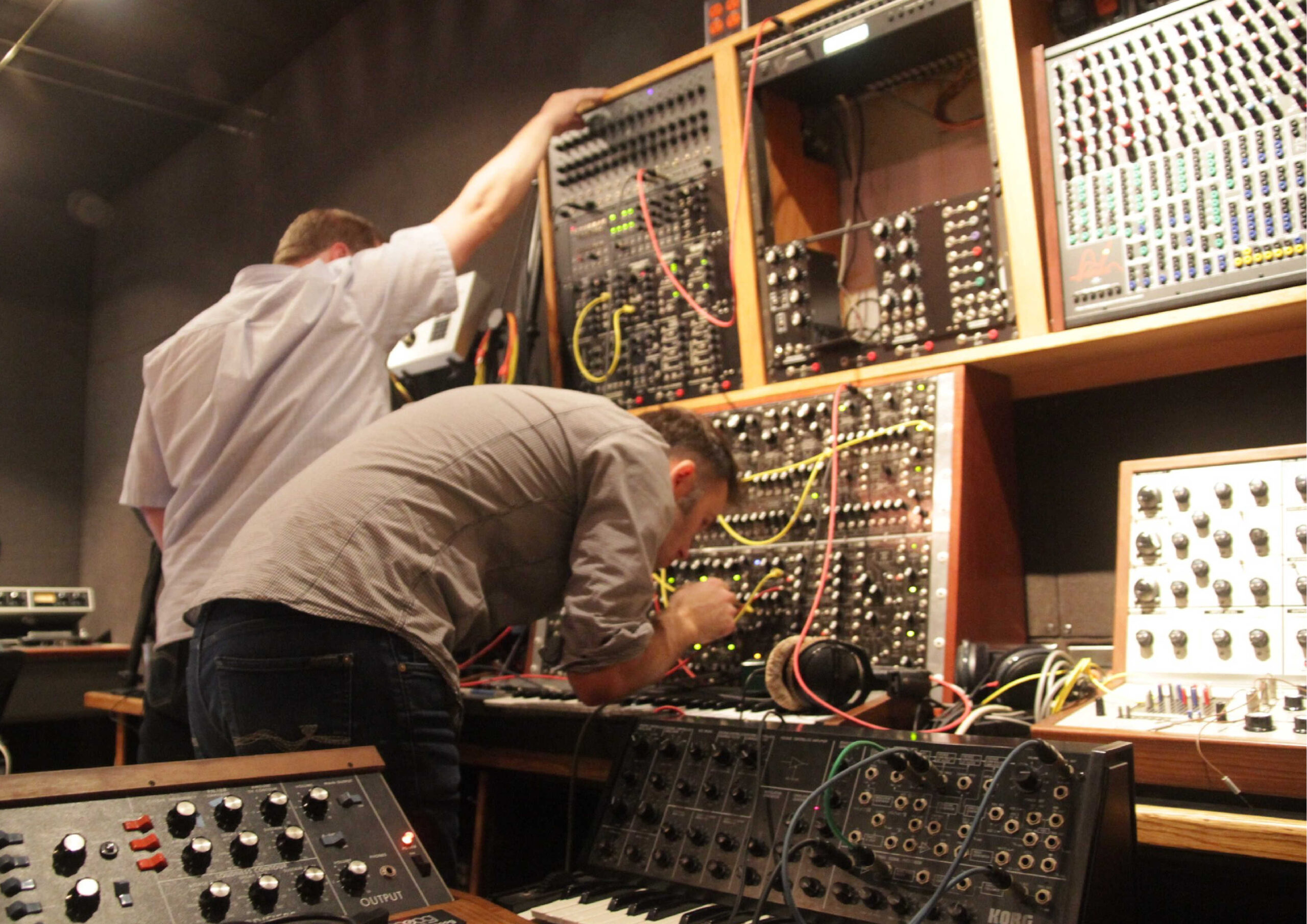
“How do I go about expressing my ideas” is a no. 1 concern from undergraduate through doctoral level composition students whom I teach daily. How do I put my sentiments and emotions into the music I want to share, and what tools do I use to achieve it? There is no easy answer to this question. We learn the craft, and the craft allows us to speak fluently. For me, it feels like chasing a dream defined as both the intangible idea you want to express and the perseverance you need to achieve your ambitions. Limitation fosters creativity is useful advice. However, I took a maximalist approach when starting this record and used an esoteric hardware sequencer called the Manikin Schrittmacher in conjunction with a dozen analog synthesizers, analog filters, and a bunch of outboard effects. The idea was to have all the devices running at the same time through various effects chains and tracking it live. So, I chose to perform real-time manipulations, sometimes with the help of multiple people/hands to change parameters and tracked all of this for future editing. The Manikin is not fun to program so there were indeed limitations which influenced the overall sound. The machine was built in the spirit of the 1970s “Berlin School” which features highly repetitive sequences and atmospheric soundscapes.
What was interesting about this technology was that the “Berlin School” style was the opposite of what I ended up with after incorporating rock instrumentation. That’s an interesting and welcome dichotomy. And sometimes I programmed “classical” music, using scores, into the machine and what came out was anything but that. Overall, I’m agnostic about the type of technology I use; though, there is a throughline of analog synthesizers, analog processors, and specific recording technologies both on this record and with Gone to Color. If we look at the voice as an instrument, then that’s a “technology” I keep coming back to.”
The modernity Walker touches upon is clarified when discussing the general subject matter that featured throughout the record. Underpinned by inequality and inefficiencies, essential answers to problems that lay in plain sight are as blindingly obvious as they are irreconcilable given the cavernous and expanding gulf of social stratification. Providing specific areas of concern, Walker explains some of the trials and tribulations that were canvased across the album. “I suppose the politicization of our healthcare system, women’s rights, and COVID were unconscious influences when I wrote the lyrics for this album. Thankfully, I didn’t experience any direct loss. I reflect on ideas such as healthcare as a right and not a privilege. I reflect on how our priorities are lost. For example, as I write we have put paediatric cancer research at risk nationwide. I mean, if we could get one thing right it seems like the former would be a good start. All this to say, the album is a way for me to digest and comment on the lack of progressive values we instil in our society. The track “Because of the Many”, the first track on the record, is a moral injunction. So, the first thing you hear on the record is a Bertrand Russell quote. Though, these things aren’t explicit on the album—they’re referential and hopefully an audience can develop their own take. I’ll take the definition of modernity as scientific and technological progress which, throughout its history, has positively shaped our collective experience as human beings. The hope is that rationality will prevail and that we continue to positively shape our future. Perhaps the slightly dystopian vibe of this album is my way of asking how we could better shape our collective society.” A fluid question that Walker himself answers when thinking about the philosophical construct of what music gives him that nothing else does? And best sums it up by quoting nineteenth-century Russian realistic fiction writer Leo Tolstoy, art is “but a means of coming together in the same feelings, and indispensable for the life and progress toward the well-being of individuals and of humanity”. A grand statement but an ideal that holds true in any era and of any artist and for those on the receiving end of Walker’s musical creations is a gift bequeathed to those who enjoy music is in purist form, free from restraint and for The Sun The Moon The Earth and Me to be another stone laid down on the long and never ending musical path for whom millions have already trodden and millions more will forever continue to tread.