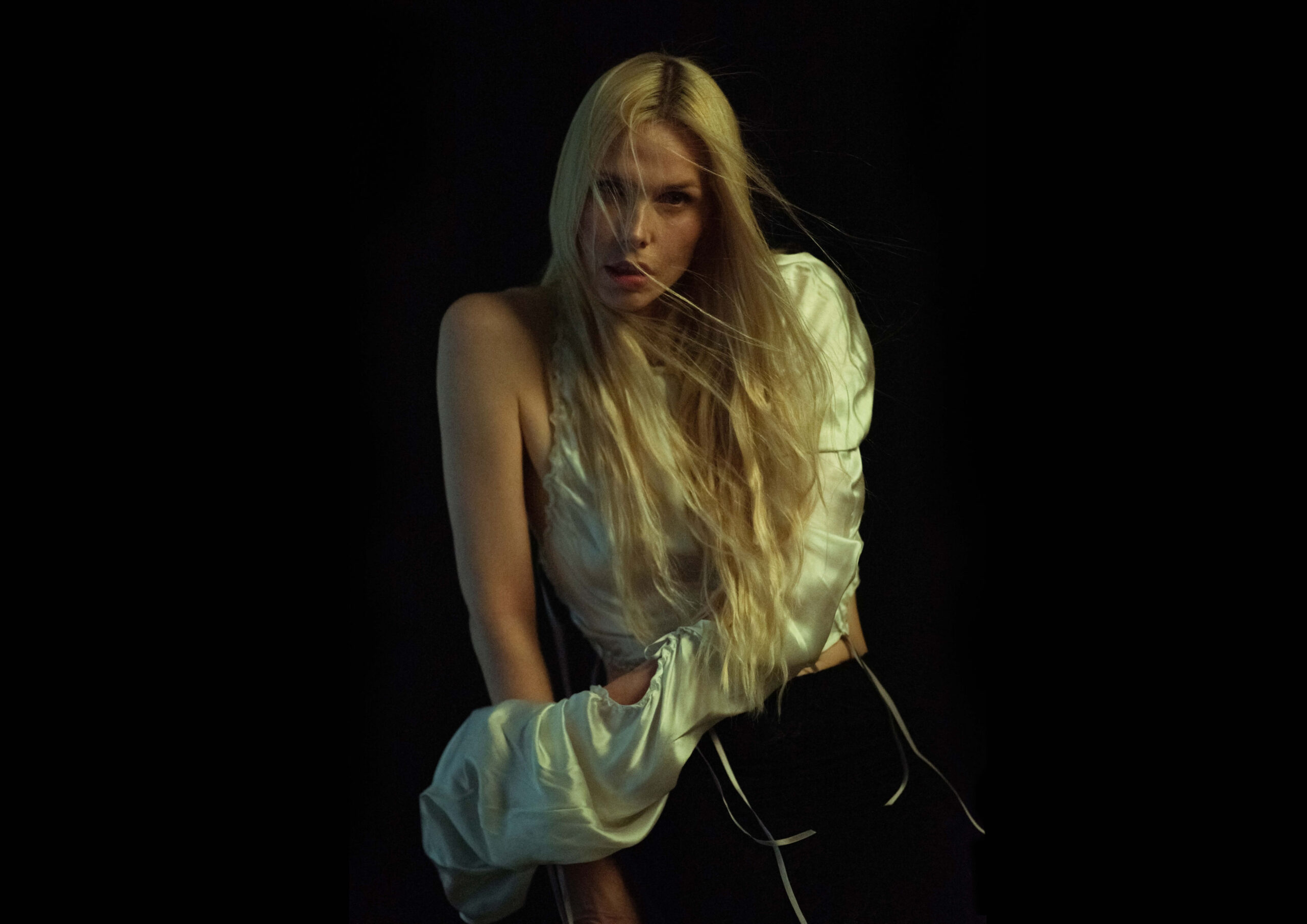
The limitations of linear movement and stifling restraints of meaning are relegated to the outer realms for Berlin artist Anna Lucia Nissen. Progression and predictability are the shackles of creativity when it comes to producing her unique works. The mystique of music and its fluidity is the allure that fosters unreserved impulse and creativity that knows no bounds and calls for no purpose. Her album Starlink is an unfettered approach that tightly channels a specialised vocabulary into an expansive space.
Hi Anna and thank you for taking the time to speak with us at Musicology.
Art is at the heart of what you do, and the various ways you express it, be it music, visual, written, or sculptural, are merely the tools used in order to fashion something grander, more significant. When working on a project, are you considering it top-down and applying each tool to carve out and shape the envisioned piece, or conversely building an idea from the ground up and organically letting the processes guide you to a conclusion?
When I listen back to the songs that are closest to me, I often genuinely don’t know how I made them. I can remember certain elements or moments, but I can’t really reconstruct the path that led from one thing to another. Making music is also a way for me to escape logic and predictability – to enter a space where I don’t necessarily understand everything that is happening.
Usually there is one particular element that becomes a starting point. It might be a line of text, a rhythm or a sound – for one song, for example, I wanted to make a beat that felt like a heartbeat. I make that first element and then see what another element might do in relation to it. When it works, I feel less like I’m constructing something according to a plan and more like I’m circling around it – almost like a moth around a light. You try something, the work responds, and then you follow it somewhere else. Sometimes nothing happens, and sometimes, after many attempts, something suddenly happens very quickly.
In a way, that is one of the things that drew me from visual art towards music. At art school, I often struggled with the expectation that a work should be explained through its meaning or references. I was much more interested in following an obsession, an image or a feeling without necessarily being able to rationalise why it interested me. Filmmakers like David Lynch or Kenneth Anger were important to me for that reason: an image can feel completely compelling without needing to explain itself or conform to a particular logic. You follow it and see where it leads.
Sonically, do you seek out the instrumentation that best mimics the sentiments you are exploring, or do you have a preconceived sound, which is then wrapped around the concept you are canvassing?
I’m very drawn to musicians who commit themselves to one instrument and build an entire world from it. There is something beautiful about that limitation because it removes so many decisions. Instead of having every possible sound available, you have one instrument and have to discover how much you can get out of it.
I try to bring some of that thinking into my own work. With digital instruments and plugins, the possibilities are essentially endless, and I find that can quickly become arbitrary or overwhelming. Over time I’ve developed a relatively limited palette that I keep returning to: my voice, lyrics and pipe organ are probably the central elements, along with looped percussion. I use a Nord Electro, so in a way the instrument itself has already given me a certain vocabulary. Rather than constantly searching for new sounds, I alter those elements – putting the organ through overdrive, shimmer or delay, for example, and changing its texture and depth. I like the idea of expanding a sound from within rather than replacing it with another one.
Percussion can come from something as simple as finger snaps, my keys or a cheap drum I have lying around, or even an LFO on my voice creating a subtle pulse. I also use field recordings and animal voices that I digitally manipulate. Those often become textures or transitions rather than conventional instrumentation.
So, I don’t necessarily choose a completely new set of instruments according to the emotion of each song. I’m more interested in finding different emotional and spatial possibilities within a relatively small vocabulary of sounds.
In what ways has your time in Anchoress influenced the way you set about your debut solo record and stepping out in this new venture?
Starlink is actually quite closely connected to Anchoress, as much of the record was co-written with my former bandmates Alexander Rathbone and Tobias Textor. So, although it is the first ANYX record, I didn’t initially approach it as a solo debut in the conventional sense. It emerged out of that transition.
My solo work had already been developing in parallel for several years. When I first started making music around 2021, I was exclusively singing while other people played the instruments. Playing in a band was very important for me at that stage, particularly because I didn’t come from a musical background. It gave me a space to learn from other musicians and, probably most importantly, to gain experience performing without having to stand on stage completely alone.
Over time, I wanted to become more independent and started teaching myself to accompany my voice on keyboards. That was a surprisingly important step. From there I developed a solo live set. It wasn’t originally intended to replace the band, but gradually I found myself playing more solo shows than band shows.
By the time Anchoress ended, performing alone no longer felt like a frightening new departure. It was something I had already grown into. I had also reached a point where I had a much clearer idea of what I wanted artistically and wanted the freedom to make certain decisions without having to negotiate every aspect collectively. So, the move into ANYX felt surprisingly organic.
Berlin is a Mecca for all things art and a city that encourages creativity. What has the city impressed upon you that your work bears some appreciation to?
I actually don’t think Berlin is particularly present in the sound or subject matter of my work. My songs tend to deal with psychological states or imagined worlds rather than specific places, so I don’t think of the music as geographically rooted.
Berlin’s influence on me is probably more structural. I’m surrounded by friends working in art, music and culture, so there is a constant exchange of ideas and a sense that making art is simply part of everyday life. The city gives me an environment in which I can make the work, rather than necessarily becoming the subject of it.
A central theme throughout your work is nature, our interaction within it, and the interconnectedness we have with the world. Simple to state but difficult to capture. How did you want to transmute your view between the two points of humans and the planet via your record?
There is a line on the record, “And in this world we’ve built, I walk alone / I dance inside my heart towards your soul,” which probably describes something quite fundamental for me. I often feel alienated from the world we have constructed. Music can become a kind of portal out of that world – another space that I can take the listener into and explore.
Nature, and particularly cosmic elements such as the sun, rain, snow and the sky, as well as animals such as bats, ladybirds, fish and birds, constantly reappear in my lyrics. But they are not necessarily the subjects of the songs; they are part of the language I use to write.
Animals and natural phenomena often take on a surreal or almost supernatural presence, and I use them to shift scale or perspective. In Ladybirds Spine, for example, a feeling of being overwhelmed by contemporary life becomes the image of being small enough to sit on the back of a ladybird’s spine – which, anatomically, doesn’t even exist. There is something almost animistic about it: the human perspective isn’t necessarily at the centre, and the distinction between ourselves and the non-human world becomes less stable.
At the same time, these images have to work for me aesthetically, lyrically and phonetically. Language is also material. Sometimes an image or phrase begins with the sound or rhythm of the words rather than with a meaning I’ve decided on beforehand.
Becoming vegan three years ago intensified this for me, because it made me question even more strongly the strange hierarchies we construct between ourselves and other animals. So, I’m not sure I really see humans and the planet as two separate points. If anything, I’m interested in challenging that distinction.
Equally challenging, the precise way in which you framed your lyricism. What was the methodology for capturing and transmitting those messages?
My process has changed over time. I used to sometimes write entire texts before there was any music, spending hours at a desk moving words around and trying different combinations. I still collect fragments constantly – words, sentences, things I overhear – and I love treating language almost as a material. I’m interested in combinations that create images which couldn’t exist in reality. Cockdust, for example, is an invented word that simply appeared through that process.
But I eventually realised that a text can work perfectly on paper and then completely fail when I try to sing it. So now I move much more between writing and singing. Sometimes I record myself improvising into a microphone before I have any actual lyrics, and something emerges phonetically. Other times I take something I’ve written and sing it, remove half the words, stretch a vowel or change the phrasing until it becomes something else.
I think singing can even empty a word of some of its literal meaning – if you stretch a vowel for long enough, at some point it becomes sound. I increasingly use my voice as an instrument too, processing it, layering it or using it as texture and harmony. But at the same time, I’m very much a lyrics person. It matters to me that the words can be understood.
There is a vulnerability in that which I find important: once a listener can actually understand what you are saying, you expose yourself in a different way.
So, for me, lyrics exist somewhere between meaning and sound. I’m interested in the point where language can begin to dissolve into sound without losing meaning completely.
Can you share with us some tracks from the album whose meanings might be at face value a little obtuse, and explain the rationale behind them?
I’m actually quite reluctant to explain what individual songs “mean”. I don’t particularly like it when a song is reduced to this song is about love, this song is about self-doubt, this song is about loss. I’m happy to talk about the circumstances in which something was written, or a feeling or image that might have initiated it, but that is different from defining its meaning.
Once I explain an image too precisely, I feel I narrow down what it can become for somebody else. Often, I don’t entirely understand where certain images or lines came from myself. So, I prefer to leave that space open for the listener.
Unlike some artists whose music is laid down on wax and there it remains enshrined for all time, your work is in a constant state of flux whereby it takes on different forms every time you perform it. What are the guiding principles when redesigning the very work you poured so much energy into shaping?
I wouldn’t say that the songs take on a completely different form every time I perform them, but I do see the live arrangements as something that can continue to evolve. I’m also not interested in recreating the studio recordings note for note.
For me, recording and performing are fundamentally different situations. A recording is experienced primarily through the ear, so I can work with detailed production, layers and subtle changes. Live, there are other parameters: the body, the space, the visual aspect and the presence of a person performing. Something can be extremely simple sonically and still hold tension for much longer because you are watching it happen.
When I translate a song for the stage, I try to find its backbone – the few elements that carry its identity and energy – and remove as much as possible around them. With Ladybirds Spine, for example, I realised that the driving guitar tremolo, percussion, organ and voice are fundamental. I tried removing the guitar but immediately felt that something structural was missing. With Window in Your Eyes, on the other hand, I can remove the drums entirely and reduce it to voice, organ and harp without losing the piece.
Sometimes performing a song makes me realise that I want to change the composition itself – extend a section, add another verse, alter a bass line or let something develop for longer. I don’t usually change the songs fundamentally, but I like allowing them to continue evolving through performance.
The aim isn’t to preserve every detail of the recording, but to retain its DNA while allowing the song to keep moving.
When sound and words are no longer applicable, such as the album artwork, how do you rely on the visuals to say everything you want to?
I don’t expect an image to say everything I want to say. I’m much more interested in an image that draws me in before I fully understand why. That was very much the case with the album cover. I had asked Michaela Knizova to photograph me because I had seen her work and immediately felt that she understood something about the world I was trying to create.
We didn’t really plan the shoot in great detail. She came to my studio, and we discovered that we both had this fascination with mirrors. So, we simply started working with one that happened to be in my studio.
When I saw the photograph that emerged from the shoot, I immediately knew it was the album cover. Only afterwards did I start making connections to ideas of perception and illusion within the record. The face you see most clearly in the photograph is actually my reflection – you think you are looking at one thing, but what you are seeing is something slightly different. Somehow that felt connected to Starlink, which began with looking up at the night sky and seeing what appeared to be stars, only to realise they were man-made satellites. In both cases, there is a small rupture between what you think you are seeing and what is actually there. None of that had been consciously staged. The image came first, and my understanding of it came later.
But that might not always be the case. For the Ladybirds Spine video, the idea was to translate the feeling of “overwhelm by contemporary life” into video by filming in shopping centers, supermarkets and Media Markt. Crowded temples of consumption to evoke the feeling of tension and narrowness.