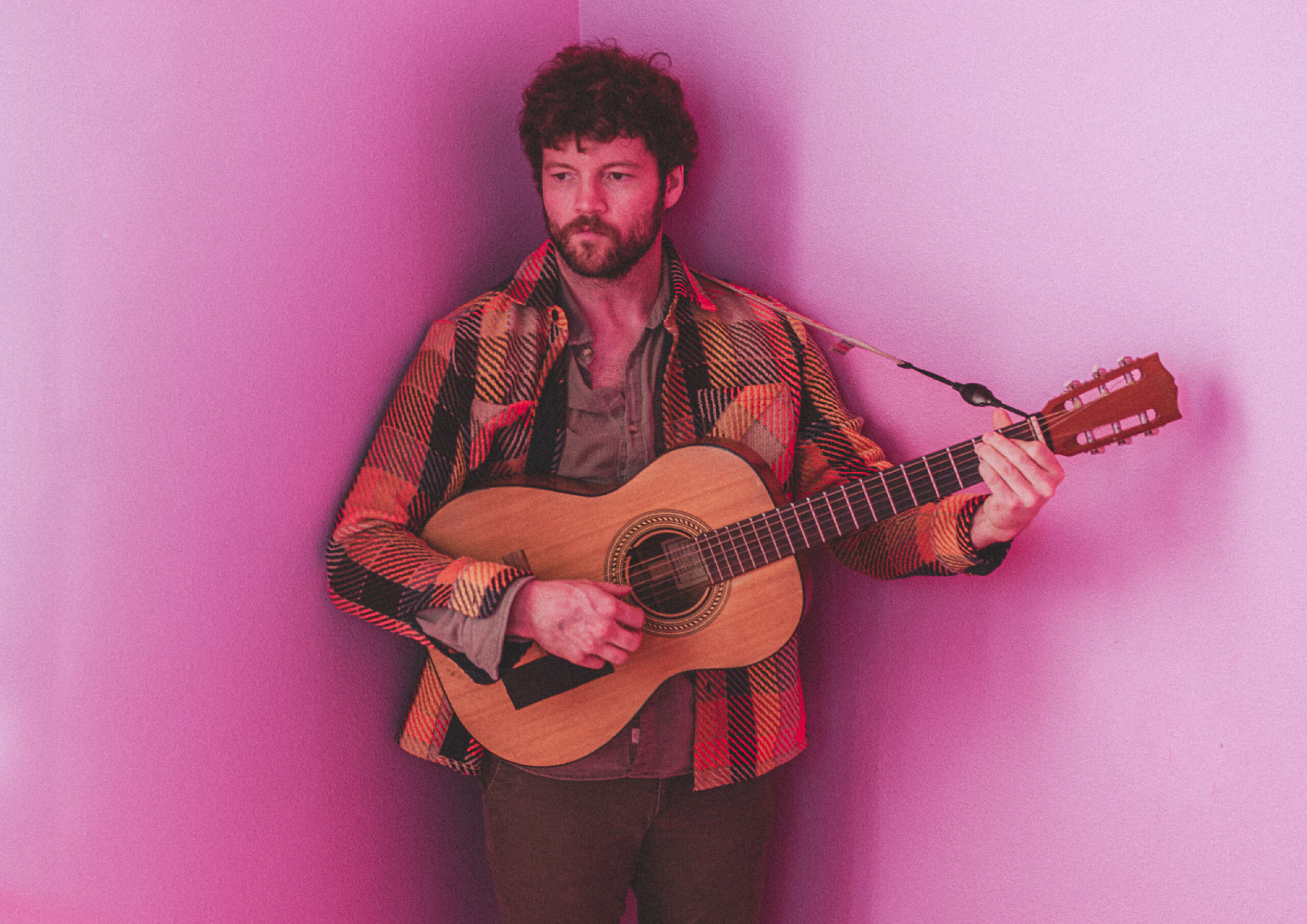
A man who wears his heart on his sleeve and heralds the truth despite the cost, what Keenan O’Meara offers up to the world is an honesty and realism that is as refreshing as it is rare. Taking personal hardships and universal grievances in his stride, O’Meara’s musical musings of such matters transcend to a higher plane. Sonically exorcising inner turmoil and processing those experiences into digestible chunks of semi-palatable reality, the exquisite musical works that represent a singular world, extend far beyond what is expectant of a single record and enters the echelon of albums that talk of humanism that opens eyes, tugs at hearts and expands minds.
Settling in the Catskill Mountains, which lay in southeastern New York State, the heavily forested area became the setting for where O’Meara would live and work, providing the refuge he sought. Working in construction by day and crafting music by night, the still ranges were home to O’Meara during the time one processes some of life’s most existential moments. The twelve tracks that came out of those deep ponderings formed Bathe In The Everlasting Light, and as O’Meara explains, translating those monumental and mortal tales was both therapeutic and pleasant despite the gravity of the subject matter. “It has been a great honor, but also a bit remedial to be able to abstract my loved ones’ lives into bits of art. In a way, it was the easiest path because it was arm’s-reach material, so I went for it and continue to do so. I wanted to embellish and distill their lives into something beautiful. It has been a joy really.”
A brave statement given that so much of the material on the album centres around that of his parents and the ever-looming reality of mortality. Yet, it was through his parents that O’Meara’s first love of music came to be as he recalls where it all started, “I think the earliest flashpoint I can remember was at the movie theatre, watching movies with my family at home. I fixated on the film scores of the great blockbusters of my time. My mother would get me a toy from Star Wars or something like that. I would sing the various themes while I played with them. I found music as an emotional language, as emotional programming, and I begged my mother to buy me CD’s of the soundtracks that I could play at home. She bought me the Jurassic Park score one day. I loved it so much and played it over and over and over. I would try and pick out parts on the piano. Snowballed from there, I suppose.” And from those earliest and incidental moments, the musical seed in O’Meara had been sown.
As the years rolled on and life took its course, O’Meara found himself working a day job and through chance and merit, crossed paths with some talented folk in the form of upstate New York friends Sufjan Stevens, Hannah Cohen, Sam Evian, Meg Lui and Oklahoma musician Zach Bryan. As O’Meara modestly states, it was between events that bookended his major musical success: “I was working as rough carpenter framing houses when I wrote the record. Now, thanks to the wonderful Zach Bryan, I have been able to subsist on music work alone. Carpentry was a tremendous writing tool. It is a wonderful creative outlet, and it is much more forgiving than art. The rules for success are more robust. You can test your talent with a ruler and level, and others’ input can be damned. It’s just you and God working it out. It’s the best. Every person on earth should build a house. You will never take shelter for granted again.”
Speaking of not taking anything for granted, the album itself, which came together because of hard work, a willingness to test one’s mettle and desire to express, was the epitome of what transpired after the record was made. As there was a completion of sorts, a full circle and closure with the passing of a parent and birth of his own child. The end and a new beginning all relatively at the same time. “I wrote this whole album before all of it ensued. In the time between receiving the master’s and releasing the record, I buried my mother, witnessed the birth of my first child, tended to my father’s recent cancer encounter after a brutal surgery and six-week hospital stint. I spent the last ten months beside hospital beds watching people pass, survive, and bring new life into the world. I feel concussed and tender these days. I don’t think I’d have been able to tackle these events as they are. That will be yet to come. This record tended to those events as abstractions, an impulse to tell stories about people I loved as I saw them.
I am still just meeting my son. I had to leave for a three-week tour four days after he was born; I came home sick and am quarantined from him as I speak. I haven’t held him since his birthday over a month ago. My life has moved quickly through enormous plot points of late and see a different person in the mirror every time I check. In my mother’s last week of life, she was able to lay her hand on Meg’s belly, to hear my sons hear beat while her own mother, who just turned 97, held her hand. Life has been replete with beauty and grief in ways I never thought possible. I get knocked off my feet a moment or two almost every day.” A personal account that can’t be faulted and as emotive as life gets. Yet given the heavy and overt topics that were occurring in and around the time of recording, some of the more subtle and quietly incidental moments that came into focus for some of the tracks were as simple as a cutoff date, as O’Meara explains, “It’s always fun to see where a deadline takes you. There are a couple tracks where I chopped myself up a bit. Had a little fun with my shadow. I like to take the parts of myself I find objectionable and personify them and abuse them. Maybe it’s the catholic upbringing or just struggling with narcissistic impulses like so many do these days. But I’m always up for a bit of masochism in my writing. Everyone should try it.”
With such heavy and idiosyncratic experiences expressed throughout the album, couching his accompanying musicians to be sympathetic toward the personal sentiments expressed and uniting their sonic contributions with his own wasn’t the Herculean task it can be for some. “I don’t think they think about it too much. When we are in the studio, we listen for dynamics, harmony, where to fill space and where to create it. It is all very downstream of the writing, maybe like actors approaching a script. We get an idea of where the inertia is, the trajectory, and we try and create contrast best we can. Mostly just trying to have fun and pull a decent day out of the ether.”
There are so many songs that are at face value, obvious in their subject matter and content, yet they hint at very specific and unique moments. Snapshots of a person, time and experiences captured by O’Meara’s music and lyricism, which can be widely appreciated as universal concepts of struggle. A notion with no finer example than that of the title track ‘Bathe In The Everlasting Light’ and its vivid description of an individual at an unimaginable low point, but a period in life which is relatable. Elaborating on this track and how he arrived at witnessing the situation and recording it for the album, O’Meara details his process. “I wanted to make a counterfeit myth, a little proto-parable for fun. I ride my motorcycle whenever I can. It’s dangerous, and I love it. I think about death the whole time; I have lost friends to them. Every time I get on it, it’s a meditation on mortality. It could very likely kill me someday. I loved the idea of a motorcycle as a chariot into the next life, figuratively, metaphorically, and literally. The song is a simple idea. What if your next ride was your last? What could the scene look like if you crossed over? I wanted to make a big-budget video about it; I wrote a short story about it. I don’t have what I need in life to make the whole picture. I am proud of the song though. I don’t think I need to write anything about limbo again.” And one way to remove ambiguity is through the instrumentation used in the studio and the sonic inspirations that help paint a clearer picture as O’Meara goes on to say when discussing ‘Bathe In The Everlasting Light’ and its assembly, “there is a theremin on ‘Bathe in the Everlasting Light’ that slowly rises in pitch, like an emergency siren. Like an ambulance on its way to retrieve our fallen protagonist.” And recalling his earlier days and the ways real life sounds morph into ideas for converting constructs, he admits, “I used to be a real sicko and just walk around Boston listening to Threnody for the Victims of Hiroshima as a student, an aural horror movie filled to the brim with instrumental mimicry. I was borrowing a bit from that.” Yet ultimately O’Meara was driven by mood and in turn what the music was redirecting back at him, as ‘there were some components that we added as an attempt to fill space in novel and fun ways. Other things were narrative specific. ‘Mourning Doves’ has tenor recorders mimicking a mourning dove call.”
At the end of the day however, it is how O’Meara feels about music and what it has done for him throughout his life that matters the most. Whether it be remembering the thrill and delight from listening to film scores as a child, imagining events from history by sounds made halfway across the globe, tinkering with music alone in the hills after a hard day’s work, through to becoming a recording artist with headline tours. “Music is gratifying in many ways, but there are two huge contrasts. It can invite attention, which nourishes the ego. Attention is underrated. We can be very safe as the subject of everyone’s gaze. It makes us feel as though we can’t be abandoned. We see this mostly as a pathology for understandable reasons. It motivates people to be dishonest, inauthentic, and even cruel. But if you call it out for what it is, it can be healthy so long as you account for the pitfalls.
Music also provides the prospect of communion with something greater than ourselves. I argue with people about this sometimes, great musicians I know who are cynical about this. But I like to believe its possible, that maybe a lifetime of work can bring some of us there. We live in an interesting crossroads as generative software threatens the modern understanding of the craft as an accessory to celebrity enterprise. Music may go back to serve as communion. Drum circles, Celtic folk sit-ins, choir groups etc etc. Music sans the ego. Who knows. It’s a great way to spend a day that’s for sure.”