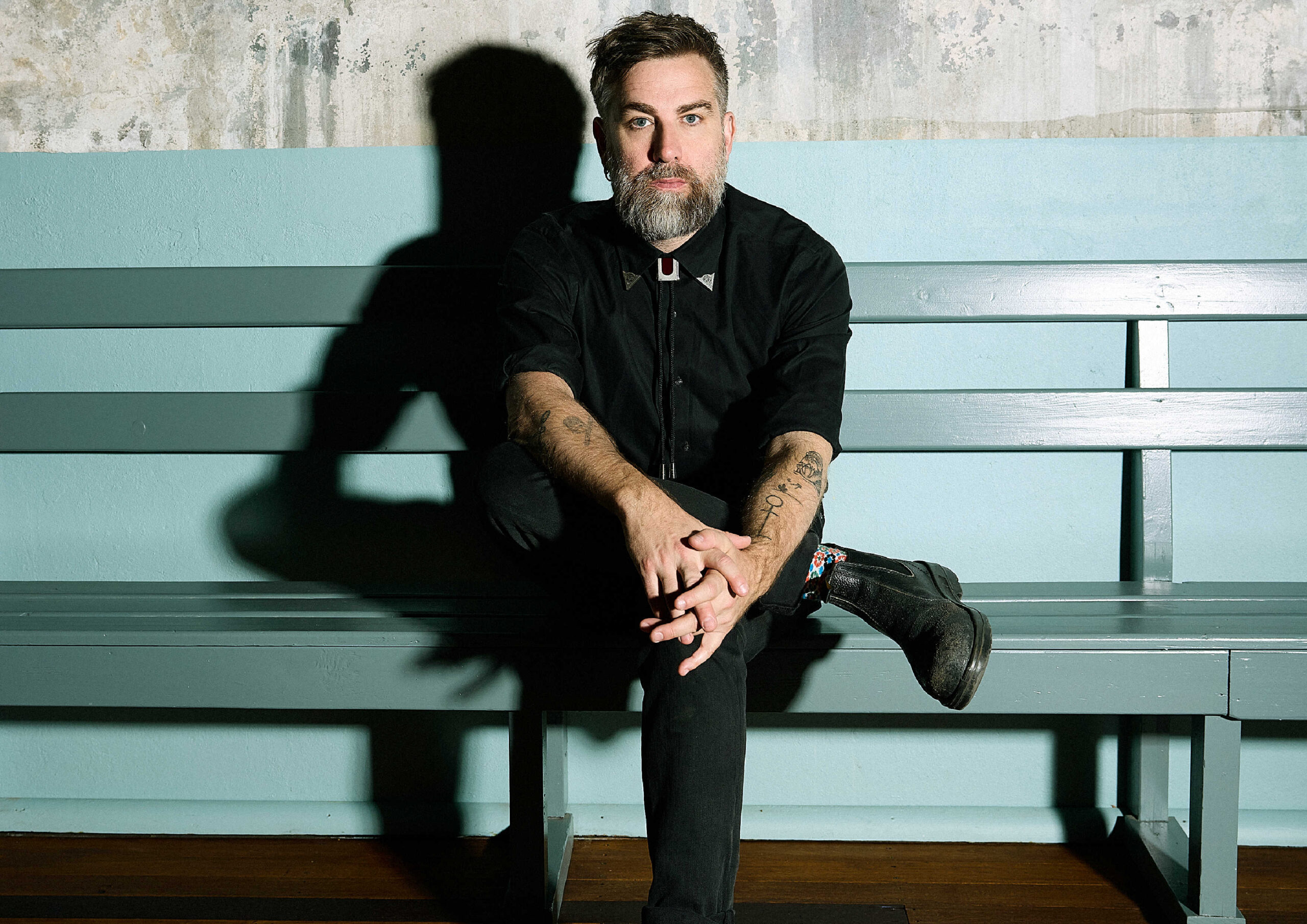
A man who has as many feathers in his cap as hats he has to wear. A musician, an author, a promoter, a charity worker, an award winner and a father. Josh Pyke is a tireless champion for musicians and an advocate for the benefits music can bring to lives. And now with his latest record Kingdom Within, we sit down to find out how he manages it all.
Hi Josh and thank you for taking the time out to speak with us at Musicology.
Your prolific creativity is only matched by the diversity of mediums and zones in which you operate in. Whether it be producing honest and emotive music, composing for film, ambassador for APRA, through writing children’s books, it seems to just flow out of you. Where would you say that deep well of creation comes from, and how do you tap to extract what you need for each project?
I honestly just feel compelled to create things. I feel a buildup of some kind of tension or energy, and the only way I know how to relieve that is to write a song or make something. Creating art, and especially songs, but also the kids’ books, is my tried and true go-to method for understanding and processing the world, and the world is a complicated and challenging place that never stops throwing up things to try to understand, so the well is kind of endlessly deep.
There is a very understated and overlooked facet of your creative space that the world needs to understand, and that is your selflessness and constant help that you provide other artists and the opportunities you give to them. Can you elaborate on just some of the projects you have started and how you have witnessed the fruits of your labour?
Thanks, that’s kind of you to say. Over the years, I’ve been involved in heaps of advocacy work through PPCA, Support Act and APRA, but also through my work with the Indigenous Literacy Foundation, where I created an annual fundraising platform that runs in schools called Busking For Change. I think the thing I’m most proud of is creating and co-funding the JP Partnership for six years. That was in collaboration with APRA, and we had amazing artists like Angie Mcmahon, Gordi, Alex Lahey and Bec Sykes come though. It’s been really gratifying seeing all those artists go from strength to strength. In general, I’m happy for people to give me a call and ask questions, because it would have been amazing for me to have had an older artist to ask about things when I was starting out.
The all-rounder that you are sees you writing and recording in tandem, which is no small feat. What have been some of the processes on either side of that spectrum that have helped you maintain that dual creative force?
Writing (whether books or songs) is a real process of kinds. Crossing your fingers and waiting for lightning to strike. I need the writing to be authentic and unforced, and sometimes that means not writing anything, or anything good at least, for months at a time. That’s been a huge learning curve over the years of just trusting that things will come, and that if I fill my cup of life with experiences, books, art in general and nature, then at some point the cup will overflow into a song or a book idea. The recording side is more reliable I suppose, in the sense that the creative process has less of a blank page about it. By the time I’ve written a song, I know how I want it to sound, and then it’s a pretty fun process of figuring out how to get the sounds in my head onto the recording. So, the two processes are really trust in the kinda divine, unknowable muse, and then trust that you have technical chops enough to manifest that.
A man of your years and experience would have seen some seismic changes within the industry, and what, in your opinion, have been some of the important improvements, and equally some of the detrimental elements over the past three decades?
I think there’s been a huge shift in professionalising the industry, in terms of work environment and trying to look after people’s mental health and things like that. We’ve had a reckoning in the industry, which is still a work in progress, but there’s been positive change there. There are a couple of elements that are harder to define as being positive or negative because they really encompass both. Streaming is a great tool for discovery, and pretty much eliminated piracy, but it has also homogenised the music industry and musical landscape to a large degree, and it does not pay artists a fair rate. Social media is also a great way to connect and spread your message as a musician in multiple and sometimes really cool and creative ways, but over all, in a general sense, it’s also one of the worst things humans have ever invented or engaged with, and I reckon in ten years we’ll look back and kinda shake our heads at the over all damage it’s done to our world.
Can you share with us some of your personal performances that were ultra special and the reasons that made them so memorable?
Playing Glastonbury back in 2007 was a real pinch-me moment. That whole year, but that show in particular really made me take a moment to go “oh this is really happening, I think this is my actual career now”. I’d been trying to do music since leaving high school 11 years earlier, so it had felt out of reach a lot of the time. Playing with the Sydney Symphony Orchestra, WASO and the Adelaide Symphony Orchestra were some of the most incredible shows I’ve done. They were hugely challenging as a musician to play, but also just to hear my songs presented in that way was very magical, very humbling. But there have also been heaps of really low-key solo gigs in regional Australia that have been amazing and memorable. Meeniyan Town Hall is always like that. When a community is totally primed to enjoy themselves, and then that energy is met with a similar vibe on stage, really memorable shows are made.
With eight studio albums under your belt and plenty of years between releases, in reflection, how do you see the music you have created in terms of what has remained universal and unwavering, through to what has perhaps been a little naive or even regrettable?
I think because I came to my solo career after having been in a punk band for ages, I was lucky enough to have formed a pretty clear vision of what I was trying to do as a musician. So, there’s nothing too cringey or regrettable thank goodness. I think the thing that I try to stick to, which helps me maintain that, is just always following my instincts as to what is authentic in a song, and not trying to manufacture a moment. I’ve found that if you just truly trust your gut, even if that means throwing away whole songs because they just inexplicably don’t feel right, then the results are better, and you’ll be able to stand by those creative decisions forever.
What was the overarching theme that you explored in your latest record Kingdom Within?
There are probably a few, but with a bit of space from the recording process, I think the main themes are facing your own mortality, finding and hanging onto what you feel is authentic in the world in a moral sense, and there’s a big component of grief in there too.
You teach music and champion its merits as your fundraising program Busking for Change attests only too well, and the beneficial impacts that come from working with the Indigenous Literacy Foundation, but what has music taught you over the course of your career?
Being a musician has taught me a lot about sticking to your guns, and defending things you really believe in. The industry is deeply flawed, and there are always multiple influences throwing their weight around when it comes to the actual creator. You have labels, managers, fans and others forming and expressing their opinions of what you should do as a creative, and it’s incredibly important to learn to trust your instincts and stick to your creative beliefs, because at the end of the day, it’s your art, and you need to be able to stand by it proudly.
A little philosophical question we ask all who kindly give Musicology their time and attention is, what does music give you that nothing else does?
Many things, but above all a capacity to tap into a weird, unexplainable, magical, rich creative space that offers me catharsis and a medium in which to process a world I find, at times, very difficult to understand.